Key highlights:
- JPMorgan said HYPE ETF inflows stalled in July
- The bank warned that U.S. perpetual futures platforms could take market share from Hyperliquid
- Prediction markets are also another source of competition for the DEX
The Hyperliquid ETF market is losing the momentum it saw earlier this year, as highlighted by analysts at investment banking giant JPMorgan. The bank said its weak inflows in July and early August could be a warning sign for HYPE as more regulated crypto trading offerings enter the U.S. market.
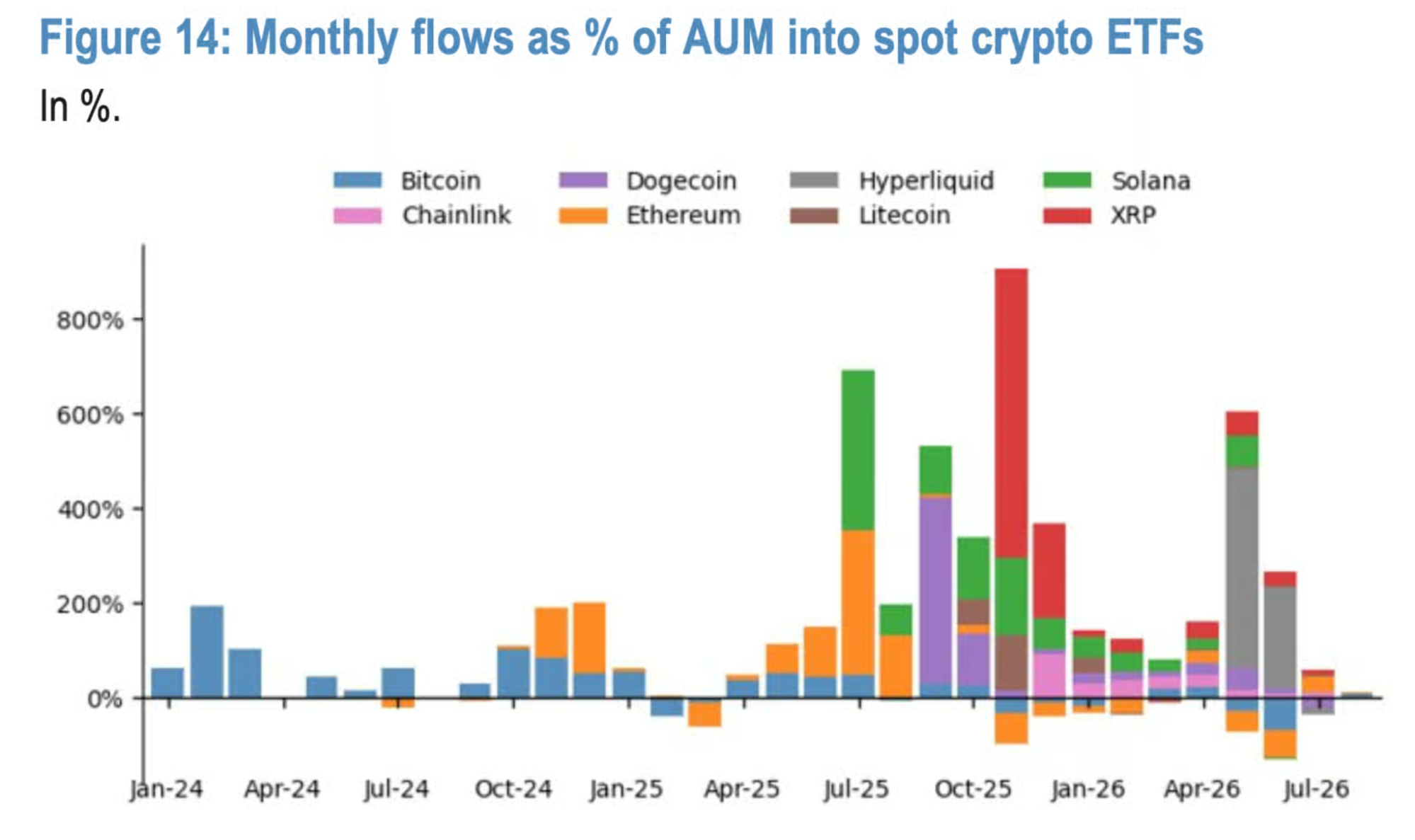
This came after a really solid May and June. HYPE linked funds saw strong inflows in these months but have since slowed.
Hyperliquid ETF daily inflows die down
JPMorgan analyst Nikolaos Panigirtzoglou said inflows for the HYPE ETF market have stalled recently, unlike what was seen in May and June.
In those months, HYPE-related funds were part of the top performers when inflows were compared with the size of their assets under management.
Notably, other funds in the crypto ETF market were performing negatively. Bitcoin and Ethereum funds saw heavy outflows in May and June. The ETFs, however, recovered in July and August. This brought a lot of attention to the DEX.
JPMorgan said investors should watch the ETF flows with Hyperliquid’s trading activity and market share. This could provide a better context on if the platform can sustain its growth.
“We see significant challenges to the market share of decentralized platforms such as Hyperliquid,” analysts led by Panigirtzoglou said.
The Hyperliquid ETF market is still much smaller than the top crypto funds. Bitcoin ETFs hold about $78 billion in assets, while Ethereum ETFs control $10.6 billion. Solana, XRP and HYPE are much smaller, with each holding an estimate of $2 billion to $3 billion.
The HYPE token was trading around $56.60 early at press time, up almost 2% in the past 24 hours.
Regulated U.S. platforms and prediction markets create competition
The major reason mentioned by JPMorgan is competition from regulated U.S. platforms. Hyperliquid has built much of its success on decentralized perpetual futures trading. These products have brought in traders looking for a lot of liquidity.
Now, in the U.S., regulated crypto platforms are also offering the same products that would potentially attract the same traders who currently use decentralized or offshore venues. JPMorgan said this could take liquidity from Hyperliquid to regulated exchanges.
“The launch of U.S.-regulated crypto perpetual futures products could accelerate a shift in liquidity away from offshore and decentralized venues to onshore venues,” the bank said.
There are also regulatory questions on decentralized derivatives platforms. These include licensing, KYC and anti-money-laundering requirements, among others.
Prediction markets are also another factor posing a challenge to Hyperliquid. The platform has expanded operations into prediction markets back in May. This came after its Outcomes platform was launched. This gave users a way to trade on real-world events.
However, this is a market that is getting saturated. The already established and newer platforms are fighting for users, liquidity and market share. This means Hyperliquid is stepping into a market where it will need to prove that it can build a strong position.
The bank said there are “significant challenges” facing decentralized platforms. It also questioned whether HYPE can take market share from larger assets like Solana and XRP.
“Whether Hyperliquid eventually surpasses in market cap other tokens such as Solana and XRP remains to be seen,” JPMorgan said.
Meanwhile, the bank noted that HYPE is the fourth-largest crypto asset held in corporate crypto treasuries, behind Bitcoin, Ethereum and Solana.
Source: Bloomberg Finance
Source:: JPMorgan Says Hyperliquid's Slowing ETF Inflows Signal Rising Competition