Key highlights:
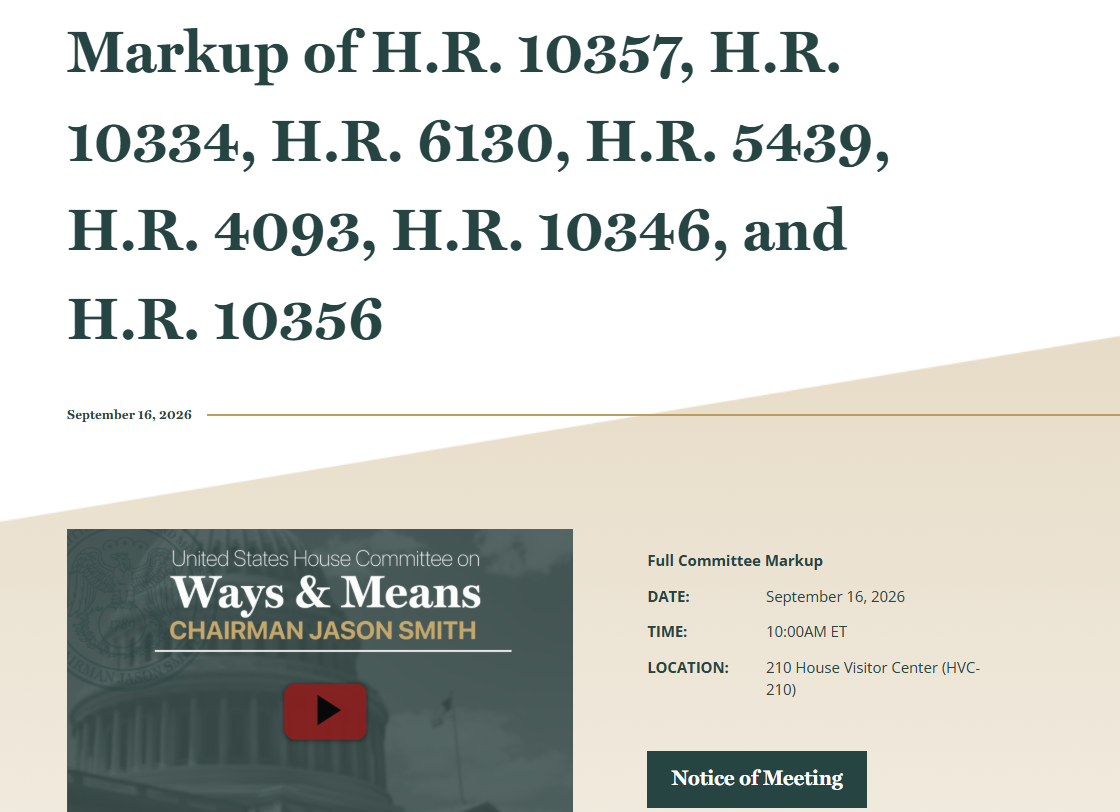
- The House Ways and Means Committee is marking up the 114-page Digital Asset Tax Certainty Act (H.R. 10357), but it excludes the provision that would have let miners and stakers defer income recognition until tokens are sold
- The bill still includes significant changes such as wash-sale and constructive-sale rules extended to crypto, a $10 de minimis exemption for network fees, and new provisions for stablecoins and digital asset loans.
- In parallel, Senate Republicans released a revised CLARITY Act, though 18 state AGs led by New York’s Letitia James are urging Congress to reject it.
The U.S. House Ways and Means Committee is set to consider a broad package of cryptocurrency tax changes on September 16, but the latest version of the legislation leaves out a proposal aimed at addressing a major tax burden facing crypto miners and stakers.
The committee is
However, the bill does not include a key provision from Representative Mike Carey’s Tax Clarity for Mining and Staking Act, H.R. 9175, which sought to change when miners and stakers become liable for taxes on newly earned tokens.
Should staking rewards be taxed before investors cash out?
The omission is significant because current tax rules can create a mismatch between when crypto income is taxed and when the recipient actually receives cash from selling the assets.
Under existing Internal Revenue Service guidance, crypto received through mining is generally taxable as income when it is received. Also, staking rewards are treated as ordinary income once the taxpayer gains dominion and control over the tokens.
Notably, the amount subject to tax is generally based on the fair market value of the assets at that time.
However, that approach can create a cash-flow problem for miners and validators.
For example, someone who receives $10,000 worth of crypto rewards could face an income tax liability based on that $10,000 valuation even if they have not sold any of the tokens.
If the asset subsequently falls in value, the taxpayer could be left with a tax bill that is larger than the proceeds available from selling the rewards.
Carey’s legislation was designed to address that timing issue by allowing eligible miners and stakers to defer recognition of income on newly generated tokens until the assets are sold or otherwise disposed of.
America needs to be the crypto capital of the world.
Our tax code needs to reflect that priority, especially for crypto stakers and miners.
I discussed the future of crypto taxes with the @IRSnews CEO at a @WaysandMeansGOP Committee hearing today: pic.twitter.com/60RNEsx3Jm
— Congressman Mike Carey (@RepMikeCarey) March 4, 2026
The provision would not have eliminated the tax. Once the tokens were sold or disposed of, the deferred amount would still have been treated as ordinary income rather than capital gains.
Notably, the proposal received support from several crypto industry groups, including the Blockchain Association, Crypto Council for Innovation, and Digital Chamber.
Supporters argued that taxing mining and staking rewards when they are received can create a liquidity problem because taxpayers may owe income tax before converting those rewards into cash.
However, the proposal also faced concerns in Congress over how long taxpayers should be allowed to defer the tax. Representative Steven Horsford, a Democrat from Nevada, previously proposed limiting the deferral election to five years.
House crypto tax bill targets wash sales, stablecoins, and digital asset loans
Although the mining and staking deferral provision was excluded, the committee’s package contains several other significant crypto tax changes.
One provision would extend wash sale and constructive sale rules to digital assets, bringing their tax treatment closer to that of stocks and other financial assets.
A related proposal, H.R. 9172, was previously estimated by the Joint Committee on Taxation to generate approximately $2.07 billion in additional federal revenue over 10 years.
The package would also create a $10 de minimis exemption for certain digital asset transactions involving network or transaction fees. Taxpayers who completed more than 5,000 transfers in the previous year would not qualify.
Other provisions address qualifying U.S. dollar stablecoins and certain digital asset loans, while directing the Treasury Department and IRS to provide additional guidance where necessary.
Could the CLARITY Act reshape crypto regulation in the US?
The House tax debate comes as Congress considers a broader regulatory framework for the cryptocurrency industry.
In the Senate, lawmakers are separately working on the CLARITY Act, which would establish a framework for determining whether different digital assets and market activities fall primarily under the jurisdiction of the Securities and Exchange Commission or the Commodity Futures Trading Commission.
Senate Republicans released a revised version of the legislation on September 10, including changes involving decentralized finance, with a procedural vote scheduled today.
The broader crypto legislation has also drawn opposition from state officials.
New York Attorney General Letitia James and 17 other state attorneys general have urged Congress to reject the CLARITY Act, arguing that it could limit states’ ability to protect investors and respond to cryptocurrency fraud.
Source:: US Crypto Tax Bill Leaves Miners and Stakers Taxed on Crypto They Haven’t Sold