Key highlights:
- The SEC proposed new crypto custody rules allowing registered investment advisers to self-custody digital assets when no eligible third-party custodian is available.
- State trust companies would get a formal custody pathway (replacing the limited 2025 no-action letter), while crypto trading platforms remain outside the framework.
- The proposal also expands eligible broker-dealer custodians beyond exchange members, adding regulated funds to the framework, and removing outdated PCAOB auditor requirements.
The SEC has proposed new crypto custody rules that would give registered investment advisers and regulated funds more ways to safeguard digital assets, including using state trust companies or, under specific conditions, holding crypto assets themselves.
The proposal would create a tailored custody framework for crypto assets while updating decades-old rules governing how investment advisers and regulated funds safeguard client assets.
The SEC said the changes are intended to address custody challenges created by digital assets and remove regulatory barriers that can make it difficult for advisers to offer crypto-related investment strategies.
The proposal, announced October 1, would amend the Investment Advisers Act of 1940 and the Investment Company Act of 1940. It would expand the institutions that can custody qualifying crypto assets and establish conditions under which advisers and regulated funds could use their own custody arrangements.
For the crypto industry, the changes could give institutional investors more options for holding assets such as Bitcoin and Ethereum as demand for digital asset exposure grows.
However, the rules are only proposed at this stage. The SEC is seeking public comment for 60 days after publication in the Federal Register, so the final requirements could change.
SEC proposal opens the door to “self-custody” for crypto assets
Under the current framework, investment advisers generally must hold client assets with a qualified custodian, such as an eligible bank or broker dealer. The rules are designed to protect investors from theft and misuse, but they were developed largely around traditional financial assets.
Crypto creates a different custody problem because ownership and control often depend on private keys.
A custodian therefore needs the technical infrastructure to secure those keys and support the relevant blockchain. When a new digital asset enters the market, suitable third-party custody services may not always be available.
The SEC’s proposal would address that gap by allowing advisers to custody certain crypto assets themselves when no eligible third-party custodian is available.
https://x.com/secpaulsatkins/status/2105752956431679818?s=46
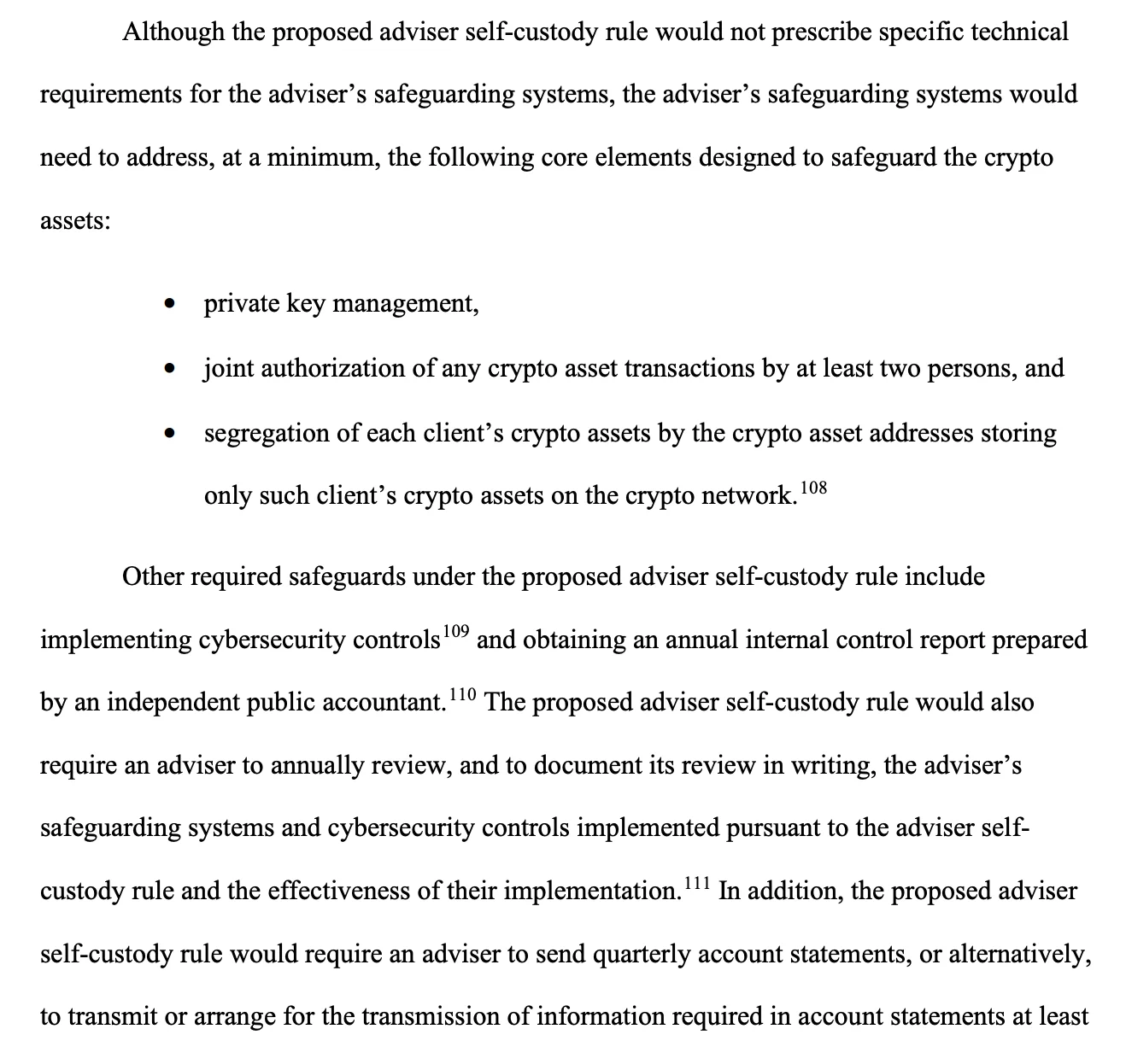
Under proposed Rule 223-1, an adviser would first have to establish that no permitted custodian can hold the specific crypto asset when custody begins. That determination would then have to be reassessed every quarter.
Self-custody would also come with several operational and security requirements.
Advisers would need documented expertise in safeguarding the asset, written policies covering private key management and cybersecurity, and controls requiring authorization from at least two people before certain custody actions can be taken.
Client assets would also have to be maintained at separate on-chain addresses, helping distinguish client holdings from the adviser’s own assets.
The proposal would add ongoing oversight as well. Advisers would need an independent internal control review within six months of taking custody and annually afterward.
Quarterly account statements would also disclose the relevant blockchain addresses, asset balances, and transactions.
Regulated funds would have a separate self-custody pathway
The SEC is also proposing a separate framework for investment companies and business development companies under proposed Rule 17f 9.
Regulated funds could hold certain crypto assets through their investment advisers if those advisers satisfy the proposed self-custody requirements. The arrangement would require additional oversight from the fund’s board.
Before the arrangement begins, the board would have to determine that the custody arrangement meets a reasonable care standard. That determination would then need to be reviewed annually.
Fund boards would also have to assess whether a permitted third-party custodian is available before adopting the arrangement and repeat that assessment every quarter.
The result is not unrestricted crypto self-custody. Instead, the proposal creates a fallback option for advisers and regulated funds when suitable third-party custody is unavailable, while adding requirements around private key security, segregation, internal controls, and board oversight.
SEC opens crypto custody to state trust companies but leaves trading platforms out
Another major change in the proposal is the SEC’s attempt to formally bring state trust companies into the crypto custody framework.
State trust companies have operated in a regulatory gray area for crypto custody. In September 2025, SEC staff provided limited enforcement relief, allowing certain state-chartered trust companies to provide custody services, but the no-action letter did not establish a comprehensive custody framework.
The new proposal would create a formal pathway for state trust companies to serve as custodians for investment advisers and regulated funds, provided they meet specific requirements.
Investment advisers and funds would first have to verify that the relevant state banking regulator authorizes the trust company to provide custody of crypto assets.
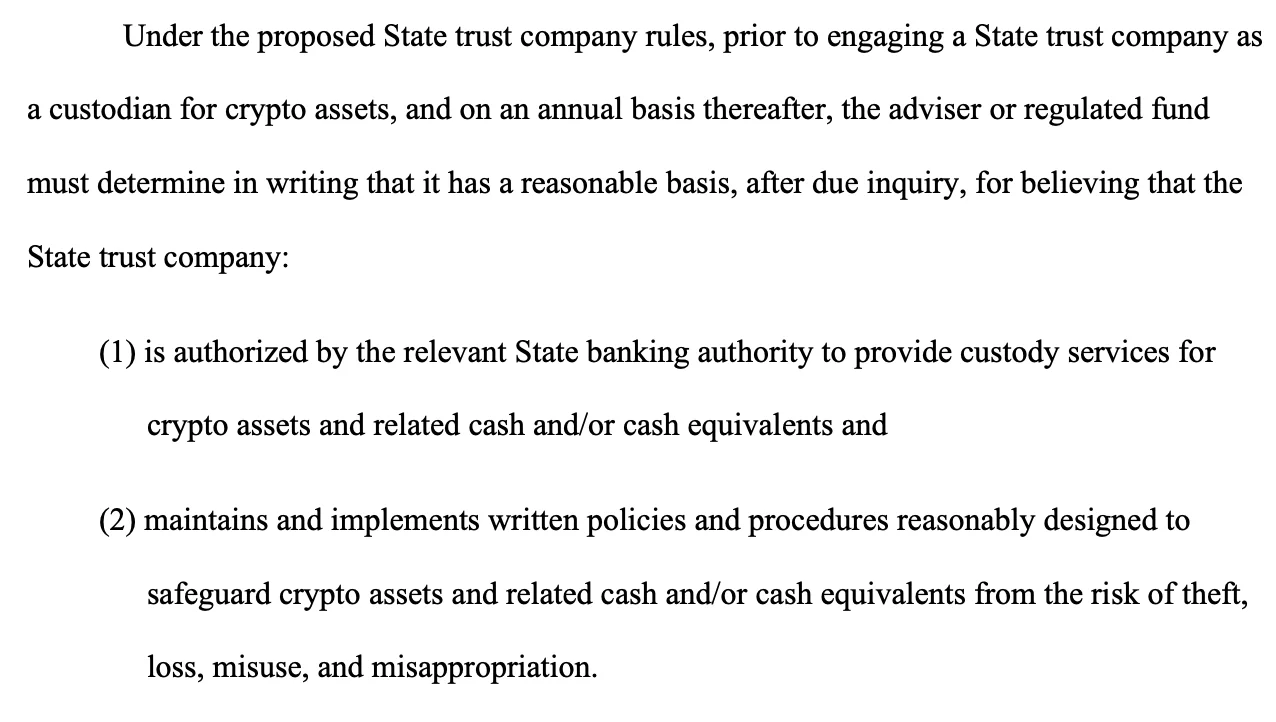
The custodians would also need written policies for safeguarding client assets, undergo appropriate financial and internal control audits, and keep client assets separate from their own holdings.
The change could expand the number of regulated institutions able to provide crypto custody services, particularly as traditional financial firms continue to build digital asset offerings.
Despite the proposed expansion of crypto custody options, the SEC is not creating a dedicated framework for digital assets held on crypto trading platforms.
The agency said it does not currently have a sufficient basis to establish specific custody conditions for those arrangements. That leaves a significant part of the crypto market outside the proposal’s new custody framework.
The SEC is instead seeking public feedback on decentralized finance and how its custody rules should apply to crypto assets held through DeFi smart contracts. For now, those assets would remain subject to existing permitted custodian requirements or the proposed self-custody framework.
SEC also proposes broader changes to traditional custody rules
The proposal goes beyond crypto by updating several custody requirements for traditional financial assets.
The SEC would allow all SEC-registered broker-dealers to qualify as custodians for regulated funds, replacing the current restriction that generally limits eligible broker-dealer custodians to exchange members.
The proposal would also explicitly bring business development companies within the relevant custody framework while removing some requirements the SEC considers outdated.
For investment advisers, the SEC would eliminate the requirement that financial statement auditors be registered with the Public Company Accounting Oversight Board. It would also update requirements covering financial statements, client notices, and surprise examinations.
Together, the changes would expand the range of institutions that can provide custody while updating rules that apply across both traditional and digital assets. For crypto, the most significant effect would be a broader regulated custody infrastructure alongside the proposed fallback for adviser self-custody.
Source:: SEC Proposed New Crypto Custody Rules — Here’s What Changes