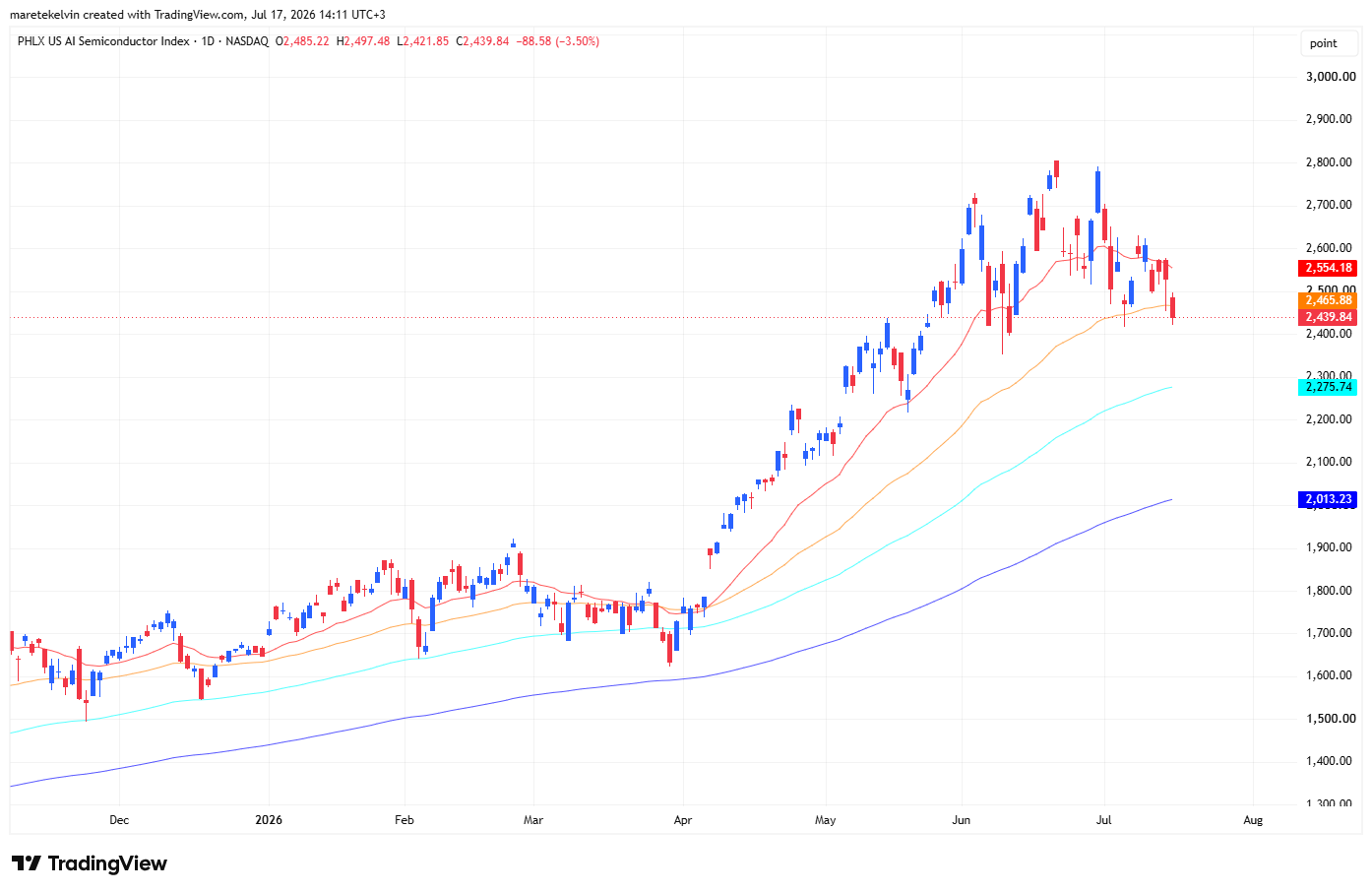
Key highlights:
- The global $3.3 trillion semiconductor industry is approaching bear market territory after a broad-based sell-off across leading chip stocks.
- Investors are taking profits following months of AI-driven gains despite continued strength in chip demand and earnings.
- Analysts remain divided on whether the correction marks a healthy reset or the beginning of a deeper downturn.
The global semiconductor industry is edging toward bear market territory after a sweeping sell-off erased hundreds of billions of dollars from chipmakers’ market value, raising fresh concerns about whether the artificial intelligence-fueled rally has finally begun to lose momentum.
The correction comes after one of the strongest runs in semiconductor history, driven by unprecedented demand for AI accelerators, high-bandwidth memory (HBM), advanced packaging and cloud infrastructure.
However, investors have recently shifted from chasing AI winners to locking in profits as valuations across the sector reached record highs.
With the semiconductor industry now valued at approximately $3.3 trillion, a decline of 20% from recent highs would officially place the sector in bear market territory.
The PHLX Semiconductor Index (^SOX) fell 4.3% on Thursday’s market close.
AI leaders lead the decline
Some of the industry’s biggest winners have also become its biggest laggards during the recent pullback.
Major semiconductor companies, including Nvidia, AMD, Broadcom, TSMC, Micron, Qualcomm, Intel and ASML, have all experienced heightened volatility as investors reassess expectations for AI spending and future earnings growth.
The broad nature of the decline suggests the sell-off extends beyond company-specific issues. Instead, investors appear to be reducing exposure across the semiconductor sector after months of exceptional gains.
The correction has also weighed on suppliers across the AI value chain, from chip designers and manufacturers to memory producers and semiconductor equipment makers.
The PHLX Semiconductor Index is now trading below both the 20-day and 50-day Exponential moving average, increasing the chances of further declines.
Valuation concerns overshadow strong fundamentals
Despite the recent weakness, the industry’s underlying fundamentals remain largely intact.
Demand for AI infrastructure continues to expand as hyperscalers—including Microsoft, Amazon, Alphabet and Meta—increase spending on next-generation data centers. At the same time, demand for advanced chips used in AI training and inference remains strong, with many manufacturers still operating near full capacity.
Recent earnings from several leading chipmakers have continued to show robust revenue growth, improving profit margins and expanding capital expenditure plans.
However, many investors believe the sector’s rapid appreciation has already priced in years of future growth, making semiconductor stocks vulnerable to profit-taking even as business conditions remain favorable.
Higher interest rates, slowing global economic growth and concerns over AI infrastructure spending have also contributed to the more cautious sentiment.
Investors watch whether AI demand can sustain the rally
The recent pullback has reignited debate over whether the semiconductor sector is experiencing a temporary correction or the early stages of a broader bear market.
Bullish investors argue that AI adoption remains in its early stages and that demand for advanced chips, high-bandwidth memory and semiconductor manufacturing equipment will continue accelerating over the coming years.
Others caution that even industries with strong long-term growth prospects can experience significant corrections when valuations become stretched.
As it stands, market participants are closely monitoring upcoming earnings reports from major semiconductor companies for evidence that AI-related spending remains resilient.
Strong guidance could help stabilize sentiment, while weaker-than-expected forecasts may accelerate the sector’s decline toward official bear market territory.
What comes next for chip stocks?
Although the semiconductor sector faces growing short-term pressure, many analysts continue to view AI as a multi-year investment cycle rather than a temporary trend.
The industry’s future will likely depend on whether corporate spending on AI infrastructure continues growing at its current pace and whether leading chipmakers can justify premium valuations through sustained earnings growth.
Until then, investors should expect elevated volatility as one of the market’s most valuable sectors attempts to find its footing after an extraordinary AI-driven rally.
Source:: Chip Stocks Extend Sell-Off as $3.3 Trillion Semiconductor Industry Faces Bear Market Risk