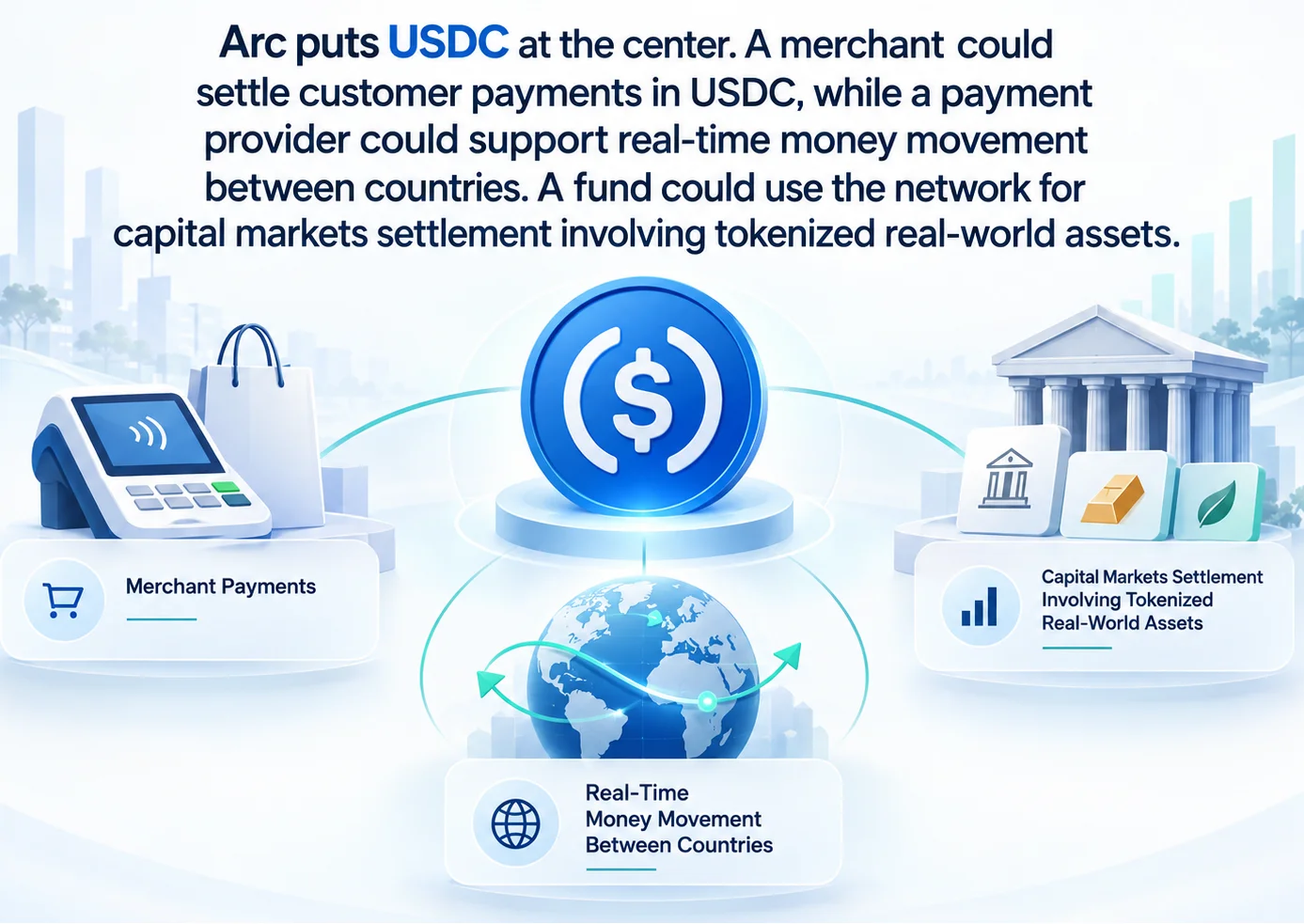
Arc chain and the ARC token serve different roles.
Arc is a Layer 1 blockchain designed for stablecoin finance, payments, and onchain financial markets.
Circle describes it as an economic operating system for stablecoin-based activity, not simply another general-purpose chain. ARC is a planned asset for coordination, security, staking, and governance.
Arc’s design targets cross-border payments and uses USDC as gas.
Its proposed performance profile also includes deterministic finality. Arc’s public mainnet launch occurred on September 16, 2026, but Circle hasn’t confirmed a public ARC launch or retail trading path.
But a live chain isn’t the same thing as a token opportunity. Let’s dive into the details.
Key highlights:
- Arc is Circle’s public Layer 1 for USDC-based payments, settlement, and financial applications, with deterministic finality
- Network fees are paid in USDC, not ARC
- Arc currently uses Proof of Authority, with a possible Proof of Stake transition discussed for 2027
- ARC has a disclosed 10 billion initial supply, but public launch details remain unresolved
- Mainnet is live, but users should treat unofficial ARC sales and airdrops as unverified
What is Arc Chain and the ARC Token: Circle’s crypto platform explained
Arc is an open blockchain built around stablecoin finance. Circle’s focus isn’t another consumer chain for memes, games, or speculative token launches. It’s infrastructure for:
- Payments
- Treasury activity
- Tokenized assets
- Financial settlement
Think of a business that accepts USDC payments across borders. It wants reliable settlement, familiar fee accounting, and fewer moving parts. Arc is designed for that type of activity, with an EVM compatible environment for developers.
Circle’s Arc mainnet announcement describes a public network with more than 100 applications and more than 100 institutional and ecosystem builders live at launch. Circle positions Arc as an economic operating system for internet-based financial activity.
- Arc’s architecture is intended to support sub-second finality under suitable conditions. It also aims to provide deterministic finality once transactions are confirmed, giving businesses a clearer settlement point
- ARC is separate. It’s the proposed native coordination asset for the network’s future security and governance model. USDC is the key transactional asset, while ARC is not described as Arc’s gas currency
Why Circle built a stablecoin-native layer 1
General-purpose chains can work for stablecoin transfers. But they often create practical friction for businesses.
Gas costs may move with a volatile token. Settlement routes can span multiple chains and bridges. Treasury teams may also need to hold a separate crypto asset simply to pay network fees.
Arc is also designed for developers building financial applications. The Circle Agent Stack can support agentic economic activity alongside payment and settlement workflows, rather than limiting the network to manual transactions.
None of that replaces banks or established payment systems. It gives those firms another public-network option for moving value.
How Arc uses USDC for fees and transactions
Most major chains use their own token for gas. Ethereum uses ETH. Solana uses SOL. Arc instead supports USDC as gas, creating a stable fee design for businesses that want more predictable network accounting.
That can make operational planning easier. A business paying network fees in a dollar-backed asset doesn’t need to budget around a separate volatile gas token.
For cross-chain transfers, users may encounter Circle’s Cross-Chain Transfer Protocol and other bridge or exchange requirements. Application designers can also consider opt-in privacy when choosing how transactions and financial activity should be structured.
In foreign-exchange and settlement workflows, the StableFX engine is intended to support more efficient movement between supported currencies and stablecoins. These tools may be relevant to payment providers, funds, and other financial applications.
Circle describes USDC as fully reserved and redeemable 1:1 for US dollars. Still, users need a compatible wallet, USDC on the correct network, and a clear understanding of bridge and exchange support.
Paying fees in USDC does not remove crypto operational risk. It changes which asset users need to manage.
How Arc works today and where the ARC token fits
Arc launched with Proof of Authority and a permissioned validator set.
This structure fits an institution-focused launch. It can make coordination more direct while the network establishes its initial payment and financial infrastructure.
Circle has also discussed a possible shift toward Proof of Stake in 2027. If it happens, ARC could have a larger role in validator security, staking, and governance.
Proof of Authority now, with a possible staking transition later
Proof of Authority relies on approved organizations rather than an open pool of token stakers. Put simply, the network starts with known validators instead of asking anyone with tokens to participate.
There is a tradeoff, though. A smaller, selected group may support easier coordination. It also raises decentralization questions because fewer parties have direct validation authority.
The proposed staking model could widen participation later. Validators would stake ARC, and the token could become part of the network’s security model. Circle has not finalized the timing, validator rules, or other mechanics.
Who is expected to use and secure Arc?
Arc’s early ecosystem is heavy on financial names. Published launch materials have named big names as examples in the founding validator cohort, including:
- BlackRock
- DTCC
- ICE
- Mastercard
- MoneyGram
- SBI Group
- Standard Chartered
- Sumitomo
- Visa
- Worldpay
- Galaxy
For financial firms, it offers institutional security with stablecoin settlement, USDC fees, public-chain access, and compliance-friendly operational controls. Circle’s validator cohort announcement gives the clearest view of the institutions involved before mainnet.
ARC tokenomics, distribution, and launch Status
Circle’s ARC token whitepaper describes an initial supply of 10 billion ARC tokens. The broad allocation is:
- 60% for ecosystem growth and development
- 25% for Circle
- 15% for a long-term reserve
The ecosystem share may cover token sales, developer grants, participation programs, and broader network growth. Circle’s allocation is intended for protocol work, governance, staking participation, and program administration. The reserve provides long-term resilience and strategic flexibility.
ARC’s published allocation framework doesn’t confirm vesting schedules, unlock dates, circulating supply, or retail distribution terms.
Reports have mentioned a $222 million private presale at a $3 billion fully diluted valuation. Those figures are reported, not confirmed public retail terms.
What ARC may do on the network
ARC’s planned role centers on participation. It may support validator staking, security incentives, network coordination, and governance if Arc adopts Proof of Stake.
That differs from paying for transactions. Arc’s stated fee asset is USDC, not ARC.
This changes the token’s possible demand profile. ARC wouldn’t rely on direct gas demand like ETH or SOL. Its utility would depend more on future staking, governance, and network participation.
That doesn’t guarantee token value. Utility and market value aren’t the same thing.
Why the ARC token launch is still unclear
Circle has been careful with its language around the ARC genesis mint. Creating tokens for network purposes isn’t a commitment to publicly launch ARC.
As of September 2026, no confirmed public token generation event, retail purchase route, broad airdrop, exchange listing, or final trading schedule was available in Circle’s public materials.
Be careful here. Fake presales, unofficial airdrops, and copied contract addresses often appear before a high-profile token has clear public terms. Reporting on Circle’s token exploration also stresses that the mint isn’t a promise of a public launch.
How Arc blockchain compares with Ethereum, Solana, and other networks
Ethereum is a broad smart contract network with a large developer and application ecosystem. Solana is built around high-throughput applications and consumer-facing activity. Arc is narrower by design.
Its main purpose is stablecoin settlement and institutional finance. That focus appears in its USDC fee model, early validator approach, and Circle’s payment and financial-market use cases.
Arc may appeal to businesses that don’t want routine transaction costs tied to a volatile gas asset. It may complement rather than replace the Circle Payments Network, depending on the use case. Arc may also have a less mature consumer app ecosystem than Ethereum or Solana.
The potential benefits of Circle’s approach
Arc brings several practical ideas together:
- Businesses can pay network fees in USDC instead of holding a separate gas token
- Circle can align the chain directly with its stablecoin infrastructure
- Payment, settlement, treasury, and tokenization apps have a network built around financial activity
- Institution-heavy validator participation may suit firms that need known operational counterparts
Circle’s official blog also frames USDC on Arc around institutional and operational use cases. The idea isn’t to focus on adoption at any cost. It’s a more direct setup for stablecoin-based finance.
The main risks and open questions for users
Proof of Authority creates centralization concerns. A future staking model has not been finalized. ARC distribution and public availability are also unresolved.
Arc depends heavily on Circle and USDC. Various factors can affect how usable the network becomes, including:
- Regulatory changes
- Crypto wallet support
- Bridge design
- Custody requirements
- Exchange liquidity
What Arc mainnet means for developers, businesses, and investors
For developers, Arc creates a place to build payment, settlement, tokenization, and financial applications around USDC. Check current documentation for deterministic finality, supported tooling, wallet compatibility, and bridge availability before deploying.
Where supported by Circle documentation, the Circle Agent Stack can connect these workflows to agentic economic activity, including AI agents as economic actors.
For businesses, the possible draw is USDC settlement with fees in the same asset, alongside treasury management. But custody, compliance, liquidity, reconciliation, reporting, and internal approval processes are still important

For investors and token watchers, always keep the distinction in mind: Arc mainnet and ARC availability are separate events. A live blockchain doesn’t mean a public token can be bought, traded, or staked today.
Final thoughts
Arc is Circle’s public Layer 1 for stablecoin-based financial activity. ARC is a proposed security, coordination, and governance token with an unresolved public launch path.
The biggest differentiators are clear: USDC-denominated fees, an institution-focused starting point, and a possible future move to a staking model. Arc is live. ARC’s public market is not confirmed.
Arc could become useful infrastructure for digital payments and tokenized finance. Until Circle confirms token distribution, governance, security, and trading details, caution is the practical move.
FAQ
Is Arc the same thing as USDC?
No. Arc is a blockchain network. USDC is a dollar-backed stablecoin that can be used on that network.
USDC is intended to handle transactions and fees on Arc. The network and stablecoin are connected, but they aren’t interchangeable products.
Is there an Arc chain token?
Yes, Circle has minted 10 billion ARC tokens as the native asset of the Arc blockchain. But, it has explicitly stated that this genesis mint is not a commitment to a public token launch.
Can people buy the ARC token yet?
Not yet. A confirmed public retail launch and broad trading route hadn’t been established in official information as of September 2026. Circle hasn’t confirmed a public sale, broad airdrop, or exchange schedule.
Treat unofficial sale pages, token claims, and listing announcements as unverified until Circle publishes direct details.
Do users need ARC to pay fees on Arc?
No. Circle’s stated design uses USDC for Arc network fees, not ARC.
Users still need a compatible wallet and enough USDC on the correct network. Wallet interfaces and support options may change as Arc develops.
Will Arc change its validator model?
Circle has discussed a possible validator-staking transition in 2027. That should be treated as a plan, not an active feature or guarantee.
The future consensus model, validator requirements, governance rules, and staking mechanics haven’t been fully confirmed.
Is Arc a good investment?
There isn’t a simple answer, especially while ARC’s public launch remains unclear. Adoption, regulation, token distribution, validator design, and the proposed staking transition all affect the risk picture.
Source:: Arc Chain and the ARC Token: Circle's Crypto Platform Explained