Key highlights:
- The ECB says central banks need to move onchain as tokenized finance expands.
- The apex bank is exploring blockchain-based settlement through projects including Pontes and Appia.
- Tokenization is tipped to balloon into a multi-trillion-dollar sector by the end of the decade.
The European Central Bank (ECB) is urging central banks to move their money and financial infrastructure on-chain as tokenization and cryptocurrencies reshape global markets. Tokenized real-world assets are projected to grow up to $18.9 trillion by 2030, with cryptocurrencies tipped to reshape the landscape for global finance.
ECB wants central bank money onchain
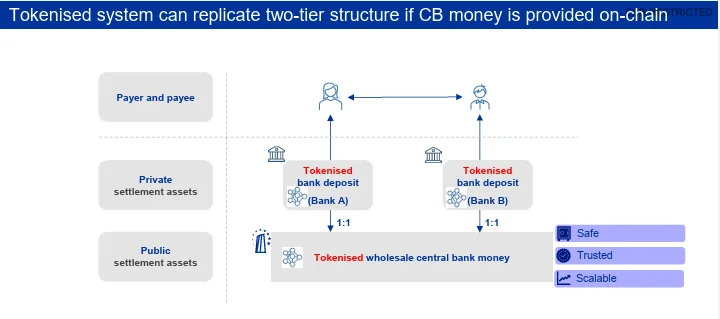
The ECB outlined the approach in a presentation titled “Central banks on-chain,” highlighting distributed ledger technology, smart contracts, and tokenized financial markets as areas where central bank infrastructure will need to evolve.
Published on October 1, the presentation argues that central bank money should remain the foundation of financial settlement as more assets move onto distributed ledgers.
The ECB sees tokenization creating new settlement models where securities, collateral, and payments can interact directly through programmable infrastructure. Per the paper, tokenization will allow transactions to settle faster and reduce the need for multiple intermediaries.
Furthermore, the central bank emphasized the importance of maintaining access to central bank money within these emerging markets rather than allowing privately issued forms of money to become the primary settlement asset.
Source: ECB
Meanwhile, the ECB has already started building infrastructure around this approach through its wholesale DLT initiatives.
Project Pontes, leaning on the XRP Ledger, is designed to connect distributed-ledger-based financial markets with the Eurosystem’s existing payment infrastructure. The initiative allows participants in DLT-based markets to settle transactions using central bank money.
The ECB is also developing Project Appia, which examines the longer-term architecture for tokenized financial markets and central bank settlement. The initiatives indicate that the ECB is moving beyond research into practical experimentation with blockchain-based financial infrastructure.
Smart contracts will reshape central banking, says ECB
The presentation also examines how smart contracts could be used in central bank operations. Potential applications include programmable repo transactions, automated collateral management and the provision of liquidity through DLT-based systems.
The ECB’s position places central bank money at the center of the emerging tokenized financial system. Rather than allowing tokenized markets to develop separately from traditional payment infrastructure, the central bank is exploring ways to connect the two.
The development comes as banks, asset managers, and financial-market infrastructure providers increasingly experiment with tokenized securities and blockchain-based settlement.
Meanwhile, the ECB is forging ahead with a central bank digital currency (CBDC) for the political bloc dubbed the digital euro. While a formal launch is earmarked for 2029, the ECB has launched a wave of pilots to test the CBDC’s utility.
Source:: ECB Urges Central Banks to Move Onchain to Keep Pace With Tokenization