By Hassan Shittu
Key highlights:
- Buterin outlined a 2030 vision for Ethereum as a “cryptographic world computer,” shifting from every node re-executing every computation to using ZK proofs to verify work was done correctly
- Hegotá is expected to be Ethereum’s last conventional fork, introducing FOCIL (censorship-resistant transaction inclusion), EIP-8141 (flexible authorization, quantum-resistant signatures), and EIP-8288 (aggregated cryptographic proofs in the mempool)
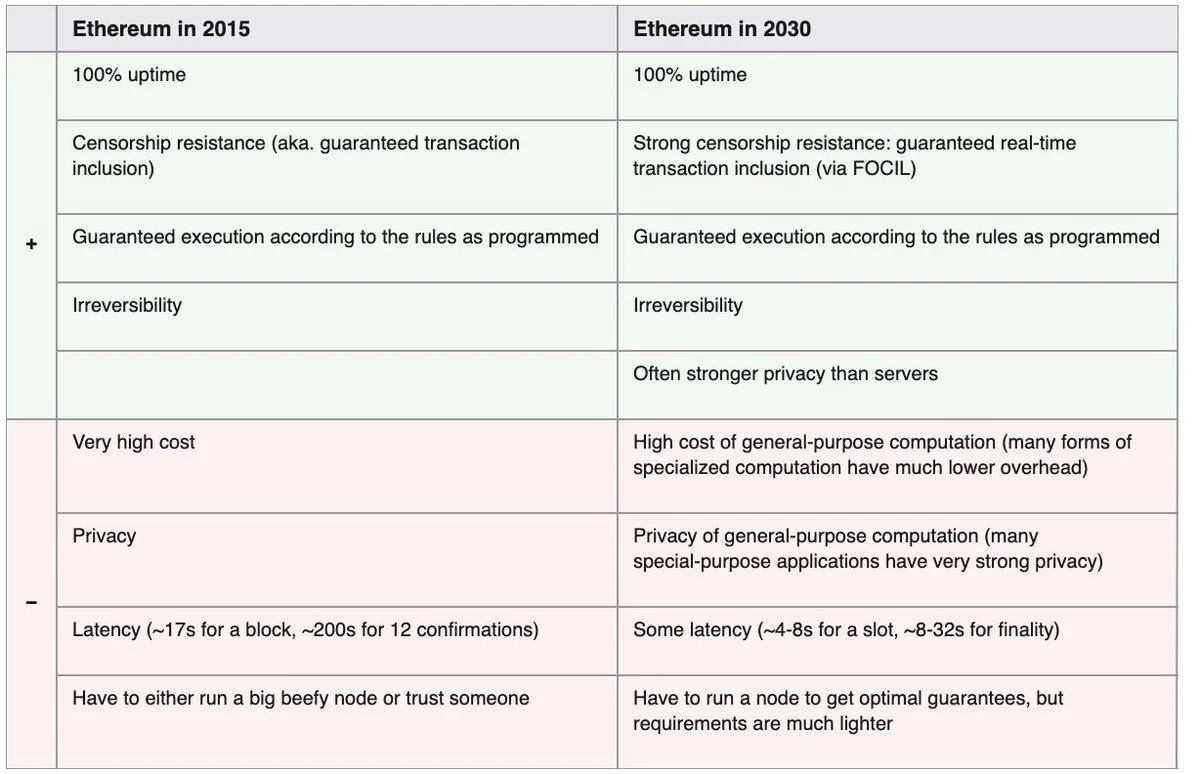
- Longer-term targets include 4–8 second block slots, 8–32 second finality, mandatory ZK proofs for private transactions, encrypted mempools, and quantum-resistant protections across all layers by December 2029
Over the longer term, Buterin envisions Ethereum moving toward block slots of roughly four to eight seconds and finality within eight to 32 seconds.
Those figures remain targets rather than confirmed delivery dates. Together, however, they show the direction of Ethereum’s proposed evolution: a network that relies more heavily on cryptographic proofs, protects more user activity through privacy technologies, and reaches consensus with less computational overhead.
Can Ethereum scale further without making its nodes more powerful?
Ethereum’s next major upgrades are expected to build on improvements already introduced through the Fusaka upgrade, including PeerDAS, which allows nodes to verify data availability by sampling portions of data instead of downloading entire datasets.
The approach reduces the amount of data individual nodes must process while helping the network confirm that information needed to reconstruct blocks remains available.
Vitalik Buterin expects Ethereum to take this approach further with zero-knowledge proofs, which can verify that a computation was performed correctly without requiring every participant to repeat the work.
The network is also preparing for longer-term cryptographic risks. The Ethereum Foundation’s Protocol Cluster has set a December 2029 target for quantum-resistant protections across Ethereum’s execution, consensus, and data layers, including changes to cryptographic systems that could eventually become vulnerable to quantum computers.
Beyond the blockchain itself, Buterin expects decentralized computing to become another part of Ethereum’s architecture.
Complex computations could be distributed across multiple participants, with cryptographic proofs allowing the network to verify the results without every node performing the same calculations.
The challenge is turning that vision into reliable infrastructure. Zero knowledge proofs still need to become more efficient, while Ethereum must manage an increasingly large state without making verification too demanding.
If those problems can be solved, Ethereum’s evolution by 2030 may be less about making the blockchain itself more powerful and more about making the network better at proving that complex work was done correctly.
Source:: Vitalik Buterin Wants Ethereum to Be More Than a Blockchain by 2030