Key highlights:
- U.S. Treasury yields moved higher as investors reacted to escalating conflict in the Middle East and monitored the latest military developments
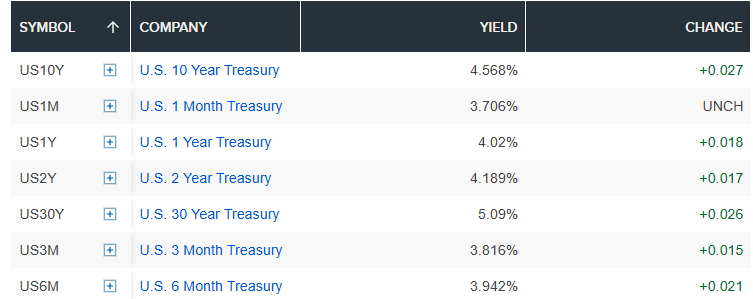
- The benchmark 10-year Treasury yield climbed to 4.568%, while the 30-year yield traded above 5%
- Markets are now awaiting the latest S&P Global Flash U.S. PMI report after recent inflation data reinforced expectations of a resilient U.S. economy
U.S. Treasury yields edged higher on Monday as investors sought to balance mounting geopolitical risks against signs that the U.S. economy remains resilient despite ongoing inflationary pressures.
The move followed another night of military action in the Middle East, with markets closely watching developments after the United States expanded its campaign against Iran.
The benchmark 10-year Treasury yield, a key gauge for government borrowing costs and broader financial markets, rose to 4.568%.
Meanwhile, the 2-year Treasury yield, which is more sensitive to Federal Reserve policy expectations, climbed to 4.189%.
That’s not all, longer-dated government debt also came under pressure, with the 30-year Treasury bond yield rising to 5.09%, while shorter maturities posted modest gains across the curve.
Treasury yields rise across the curve
According to market data, Monday’s move saw yields increase across nearly every major Treasury maturity.
Usually, treasury prices and yields move in opposite directions, the increase in yields reflected modest selling pressure in government bonds as investors reassessed risk.
Middle East conflict continues to drive safe-haven demand
Geopolitical tensions remained a key focus for investors after the United States intensified its military campaign against Iran, completing a ninth consecutive night of airstrikes targeting military command centers, air defense systems, missile and drone launch sites, and coastal infrastructure.
In a recent statement, U.S. Central Command said the operation was aimed at degrading Iran’s ability to threaten commercial shipping and military assets across the Gulf.
CENTCOM began conducting a new wave of strikes against Iran at 7 p.m. ET today for the ninth consecutive night. The strikes will continue degrading Iranian military capabilities used to attack commercial vessels and civilian mariners transiting the Strait of Hormuz.
— U.S. Central Command (@CENTCOM) July 19, 2026
The conflict has expanded beyond direct U.S.-Iran exchanges. Iran launched fresh retaliatory strikes against U.S.-aligned targets in Kuwait, Bahrain and Jordan, while regional air defense systems intercepted multiple drones and missiles.
Shipping through the Strait of Hormuz remains under intense scrutiny after Iran renewed threats to disrupt maritime traffic. The strategic waterway handles roughly one-fifth of global oil shipments, and any prolonged disruption could significantly impact global energy markets.
Reports of attacks on commercial vessels and continued military operations near the strait have already pushed oil prices higher and increased demand for traditional safe-haven assets such as the U.S. Treasuries.
Despite the escalating military activity, diplomatic channels remain open. U.S. officials have reiterated their willingness to pursue negotiations if Iran returns to compliance with previous agreements, while Iranian officials have acknowledged receiving mediation proposals from regional partners.
However, with both sides continuing military operations, investors remain cautious as geopolitical uncertainty continues to shape global financial markets. Crypto markets have already felt the impacts of the war.
Economic resilience tempers safe-haven demand
Despite heightened geopolitical uncertainty, Treasury yields remain well above last week’s lows after a series of economic reports suggested the U.S. economy continues to absorb inflationary pressures.
Recent consumer and producer price data came in cooler than expected, easing concerns that inflation is accelerating again.
At the same time, U.S market inflation is expected to be reduced according to the latest news release. Last Friday’s Prelim UoM Inflation Expectations data projects a 0.2% reduction of the inflation rate to 4.4%.
Those developments have complicated the outlook for Federal Reserve policy, with investors weighing whether strong economic activity could delay future rate cuts even as inflation gradually cools.
Markets turn attention to PMI data
Investors are now looking ahead to Friday’s S&P Global Flash U.S. PMI report, which provides one of the earliest monthly snapshots of activity across the manufacturing and services sectors.
A stronger-than-expected reading could reinforce expectations that the U.S. economy remains on solid footing, potentially keeping upward pressure on Treasury yields.
Conversely, signs of slowing business activity may revive expectations for monetary easing later this year, supporting government bond prices.
As it stands, Treasury markets remain caught between resilient economic fundamentals and escalating geopolitical risks, leaving investors closely watching both Washington’s policy signals and developments in the Middle East.
Source:: U.S. Treasury Yields Edge Higher as Middle East Conflict Fuels Market Caution