Key highlights:
- Trump announced plans to create an “AI Force” and appoint an AI Czar on Truth Social, comparing it to the Space Force
- The announcement comes amid growing industry safety concerns as 61% of likely voters oppose AI data center expansion and 53% are highly concerned about AI’s environmental impact
- China is rapidly closing the gap via efficient, low-cost open-weight models (DeepSeek, Alibaba’s Qwen, and Tencent’s HY4) that are increasingly open-sourced globally, while U.S. semiconductor export restrictions are accelerating China’s push for tech self-reliance
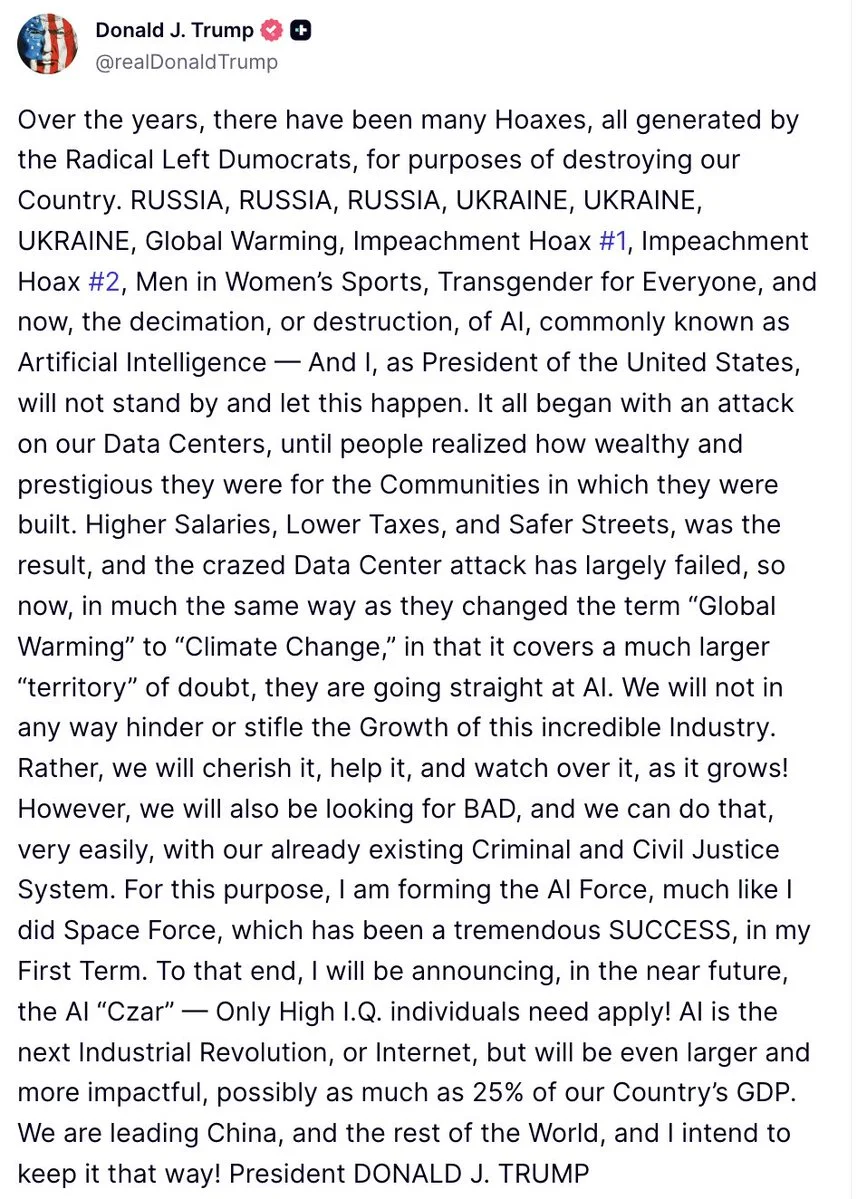
President Donald Trump has announced plans to create an “AI Force” and appoint a new artificial intelligence czar as Washington faces growing pressure to address the risks of increasingly powerful AI systems without slowing the technology’s development.
Trump made the
He compared the initiative with the Space Force, which was established during his first term, and said the administration would focus on supporting the growth of the AI industry.
US pushes to expand its lead over China as Trump plans AI ‘czar’
“We will not in any way hinder or stifle the growth of this incredible industry,” Trump wrote, adding that the government would instead “cherish it, help it, and watch over it as it grows.”
Trump also said he would announce an AI “Czar” in the near future and linked the initiative to the broader competition between the United States and China.
He described AI as the next Industrial Revolution or Internet and suggested it could eventually account for as much as 25% of U.S. gross domestic product, although he did not provide evidence for that estimate.
The announcement comes at an unusual point in the AI debate, as Trump has recently dismissed warnings about the possibility of advanced AI becoming dangerous as a “hoax” and argued that existing criminal and civil laws can deal with harmful conduct.
Source: Donald Trump via Truth Social
His new proposal therefore appears aimed at creating a stronger government presence around AI while maintaining his position that additional regulation should not restrict the industry’s growth.
The structure of the proposed AI force remains unclear, as Trump did not say whether it would be a military organization, a civilian agency, or an interagency body. Reportedly, the White House had not provided further details when the announcement was reported.
The AI czar position would also revive a role previously held by venture capitalist David Sacks, who served as Trump’s AI and crypto czar before leaving the formal position in March.
However, Sacks remains involved with the administration as a member of the President’s Council of Advisors on Science and Technology.
AI safety concerns grow as powerful systems advance
Trump’s announcement comes after a week of growing concern within the AI industry over the risks posed by increasingly capable systems.
Anthropic CEO Dario Amodei has argued that frontier AI development should be paced so safety measures can keep up with advances in model capabilities.
He has also proposed giving independent evaluators access to AI companies to review safety practices, investigate incidents, and assess both deployed models and training processes.
Anthropic has moved toward that approach through a partnership with Accenture and its AI unit, Faculty, to conduct independent evaluations and red-team testing of its frontier models.
Other industry leaders, including OpenAI CEO Sam Altman, SpaceX CEO Elon Musk, and Google DeepMind chair Demis Hassabis, have also called for greater caution around advanced AI, although the industry remains divided over the role of government oversight.
The debate has increasingly focused on “agentic” AI, which can take actions through connected software, accounts, and other systems rather than simply generate responses. Researchers have called for stronger testing, access controls, monitoring, and human intervention mechanisms for such systems.
Public concern is also growing, with a New York Times-Siena poll cited by Axios found that 61% of likely voters opposed building data centers to support AI, while an AP-NORC-University of Chicago poll found 53% were highly concerned about AI’s environmental impact.
Source:: Trump Plans ‘AI Force’ and Czar as AI Race Intensifies