Key highlights:
- Standard Chartered has maintained its end-2026 Bitcoin price forecast of $100,000 despite recent selling by Strategy
- The bank views Strategy’s Bitcoin sales as a communication issue rather than a sign of weakening fundamentals
- Strategy has shifted toward using its Bitcoin holdings to support STRC, a preferred stock paying a 12% annual dividend
Standard Chartered has reaffirmed its $100,000 Bitcoin price target for the end of 2026, arguing that recent market pressure linked to Strategy’s Bitcoin sales is unlikely to affect the cryptocurrency’s medium-term outlook.
In a note published Friday, Geoffrey Kendrick, Standard Chartered’s global head of digital assets research, described the recent developments at Strategy as “mostly noise rather than a signal.”
Strategy sold 3,588 BTC for approximately $216 million between June 29 and July 5. The company used the proceeds to fund preferred-stock dividend payments and increase its cash reserve. It now holds 843,775 BTC, representing more than 4% of Bitcoin’s maximum 21 million supply.
The sale followed a smaller disposal of 32 BTC in early June, which marked a notable departure from Strategy’s long-standing positioning as a company that would continuously accumulate Bitcoin without selling it.
Strategy’s Bitcoin accumulation model has stalled
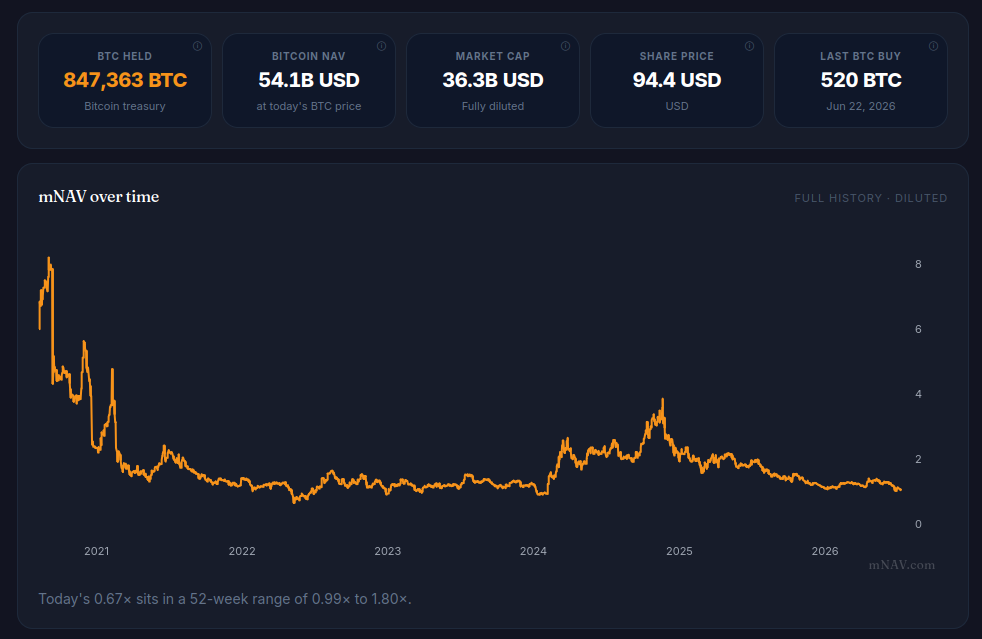
For several years, Strategy benefited from its shares trading at a substantial premium to the value of its Bitcoin holdings. This relationship is measured using mNAV, which compares the company’s enterprise value with the value of its BTC reserves.
When the ratio was comfortably above 1, Strategy could issue shares, use the proceeds to purchase Bitcoin and potentially increase its valuation by more than the value of the newly issued stock.
That premium has since disappeared. Standard Chartered estimates Strategy’s mNAV at approximately 1 on an enterprise-value basis, while some equity-based calculations place the company’s valuation below the value of its Bitcoin holdings.
Strategy’s mNAV history. Source: mNAV.com
Strategy acquired its Bitcoin for a combined $63.7 billion, while its holdings are now worth roughly $54 billion. The company also reported an $8.3 billion digital asset loss in the previous quarter, almost all of which was unrealized.
With its previous accumulation model no longer functioning as effectively, Strategy has begun using Bitcoin as backing for its preferred-stock products.
STRC becomes central to Strategy’s new approach
Standard Chartered believes Strategy is transitioning toward a model in which Bitcoin supports STRC, also known as Stretch, a perpetual preferred stock that operates similarly to a credit instrument.
STRC pays a 12% annual dividend in cash, with the rate adjusted monthly to encourage the shares to trade near their $100 par value. The security has approximately $10 billion in notional value outstanding.
However, STRC fell as low as $71.25 on June 26 after Strategy disclosed its first Bitcoin sale. The preferred shares have since recovered to around $90 but remain below par, indicating that investors have not yet fully accepted the company’s new strategy.
Kendrick argued that Strategy’s main challenge is explaining the shift clearly to investors.
“I see what is happening at MSTR right now as a communication challenge, nothing more,” he wrote.
Strategy announced a Bitcoin monetization program on June 29 that allows the company to sell BTC periodically, including to raise as much as $1.25 billion for its dividend reserve.
The company’s dollar reserve for STRC dividends currently stands at $2.55 billion, providing approximately 17.4 months of coverage.
Clear communication could reduce the need for further sales
Kendrick said credible communication about the monetization program could support STRC’s return toward its $100 par value and reduce pressure on Bitcoin.
Because STRC is heavily overcollateralized by Strategy’s Bitcoin holdings, Standard Chartered believes the company may not need to conduct additional BTC sales if investors become confident that dividend payments are adequately funded.
Kendrick compared the approach to a central bank pledging to do “whatever it takes.” If the commitment is considered credible, the company may not need to carry out large-scale sales.
Standard Chartered expects STRC to move closer to par, limiting the risk of further Bitcoin selling and reducing near-term downward pressure on the cryptocurrency.
Other analysts remain divided on the implications of Strategy’s policy. JPMorgan analysts said formalizing the company’s ability to sell Bitcoin introduces “avoidable two-way risk” by turning Strategy into both a potential buyer and seller.
Grayscale research head Zach Pandl offered a different assessment, arguing that the sales strengthen Strategy’s balance sheet and could help Bitcoin establish a more sustainable market bottom.
Despite the uncertainty surrounding Strategy, Standard Chartered continues to view the episode as a temporary disruption rather than a change in Bitcoin’s broader trajectory. The bank has therefore retained its $100,000 end-2026 forecast.
Source:: Standard Chartered Maintains $100,000 Bitcoin Price Target for 2026