
A no-commission forex trading account isn’t free. The broker still gets paid, usually through a wider spread built into the price you see.
Raw spread accounts work differently. You may see a much tighter spread, then pay a separate commission when you open and close the trade. When evaluating your total trading costs, the better choice depends on:
- How often you trade
- Your position size
- Live execution
- Broker’s actual terms
I’ll break down the pricing, run a simple EUR/USD example, and match each account type to trading styles.
Key highlights:
- Raw spread accounts often use tight, market-based spreads plus a separate commission, which provides greater pricing transparency for your trades
- No-commission accounts include the broker’s markup inside a wider spread
- Frequent traders can find these accounts to be a cost-effective solution, provided that commissions and execution remain competitive
- Swing traders may care more about forex swaps than saving a few tenths of a pip at entry
- Always compare live spreads, round-turn commission, slippage, and regulation before opening an account to minimize your overall trading costs
How raw spread vs no commission forex accounts work
Both account types charge for access to the market. But the difference is where you see the cost.
A raw spread account separates the expense into two parts:
- The bid-ask spread
- A commission
These accounts are often provided by ECN brokers or STP brokers who offer direct access to interbank pricing.
Conversely, a zero commission account rolls the broker compensation directly into the bid-ask spread.
Here’s the basic comparison:
| Account type | Spread shown | Separate commission | Main appeal |
| Raw spread | Usually very tight | Yes | Lower entry cost for active trading |
| Zero commission | Usually wider | No | Simple, all-in pricing |
| Spread-only accounts | Broker-marked-up spread | Usually no | Easier cost tracking for casual traders |
The label is more important than the total number. A zero spread offer can still cost more than a 0.8-pip standard spread if its commission is too high.
What the advertised spread and commission really mean
A broker’s minimum spread is not the same as its average spread. Neither is the same as the spread on your screen when you place a live trade.
In liquid conditions, raw spreads on major pairs like EUR/USD may sit near 0.0 to 0.2 pips. Spread-only accounts may show roughly 0.6 to 1.0 pip or more. Those figures change by:
- Broker
- Account currency
- Trading platform
- Region
- Market volatility
- Liquidity
Let’s talk about commission. A round-turn commission is the total fee to open and close a standard lot. Some forex brokers quote a fee per side. Others show the complete round-turn amount.
For example, $3.50 per side means $7 total for the full trade. Do not compare that figure with another broker’s $3.50 round-turn charge, as they’re not the same thing.
Zero commission doesn’t mean zero trading costs
A spread is the gap between the buy price and sell price. When you buy, you enter at the ask. If you immediately sold, you would exit at the lower bid.
That gap is your immediate unrealized loss before the market moves.
Assume EUR/USD has a 0.8-pip spread on a zero commission account. For one standard lot, where one pip is roughly $10, your starting cost is about $8.
Now assume a raw account shows a 0.1-pip spread and charges a $7 round-turn commission. The spread cost is about $1, plus $7 in commission. Your total is also about $8.
Put simply, a tight spread does not automatically make the raw account cheaper. Poor fills, high commissions, broker markup, and overnight financing can erase the apparent advantage.
Which account is cheaper? Compare the total trading cost
To determine the most economical option, you must calculate the total trading cost for your specific style.
This is the formula:
Total trading cost = spread cost + round-turn commission + slippage + overnight charges, if held
For EUR/USD, the pip value is about $10 for one standard lot, $1 for a mini lot, and $0.10 for a micro lot when the account is denominated in USD.
This means a $7 fixed commission on a standard lot usually scales down proportionally. A 0.10 lot trade would incur about $0.70 in commission. Similarly, a 0.01 lot trade, which is one-tenth of the size of a 0.10 lot, would cost about $0.07 in commission.
A cost example for scalpers and active day traders
Small differences in pricing become significant when you repeat them frequently.
Suppose a scalper completes 20 EUR/USD round-turn trades of one standard lot in a week. One account costs $8 per trade, while another costs $10. The difference is $40 that week. Over 200 similar trades, it becomes $400.
This is why commission-based accounts often fit those focused on intraday trading. For active day traders, raw spreads are generally more cost-effective than spread-only accounts because they result in a lower total trading cost over high volumes. Because their profit targets may be only a few pips, an extra half-pip at entry is a meaningful hurdle.
But still, lower costs do not fix careless execution. A commission is charged on every trade, including weak setups, rushed exits, and revenge trades. Frequent trading magnifies your savings, but it also magnifies your mistakes.
A low-cost account helps a tested strategy. It doesn’t turn a poor strategy into a profitable one.
When the wider spread may be worth the simplicity
A no-commission account can be easier to manage. The quoted spread displays the main trading cost upfront, meaning there is no separate open-side or close-side fee to track.
That simplicity works well for:
- Beginners
- Casual traders
- All those who place a small number of longer-term positions
If you make only two trades per month, shaving a fraction of a pip off the spread doesn’t make a big difference.
A wider spread can also be easier to factor into a trade plan. You know the trade starts negative by the amount shown on your screen. So, you can set your stop and target with that cost in mind.
The issues happen with scale. A spread-only account that feels simple on small lot sizes can become expensive on larger positions.
Raw spread vs zero commission: which traders benefit most?
Start with your actual behavior:
| If this sounds like you | Account type to consider |
| You scalp or trade high-volume currency pairs | Raw spreads, after checking all-in cost |
| You want simple pricing for major currency pairs | No commission or standard spread |
| You trade a mix of short and long holds | Compare both based on your typical currency pairs |
| You hold positions for days or weeks | Compare swaps before focusing on spread |
Account type by itself doesn’t improve a weak strategy, remove risk, or promise better results. It only changes the price you pay to enter and exit.
The best pricing model for scalping, news trading, and swing trades
Scalping strategies are highly sensitive to a few tenths of a pip. Tight live spreads are helpful, but execution quality and liquidity are equally important because you enter and exit the market frequently.
A raw account is usually the first place to look, provided the broker maintains deep liquidity and reliable order handling during your specific trading hours.
News traders face unique challenges. During periods of high market volatility, spreads can widen rapidly, and significant slippage can occur on either account type. Remember that a raw account does not guarantee a fill at your expected price when the market moves abruptly.
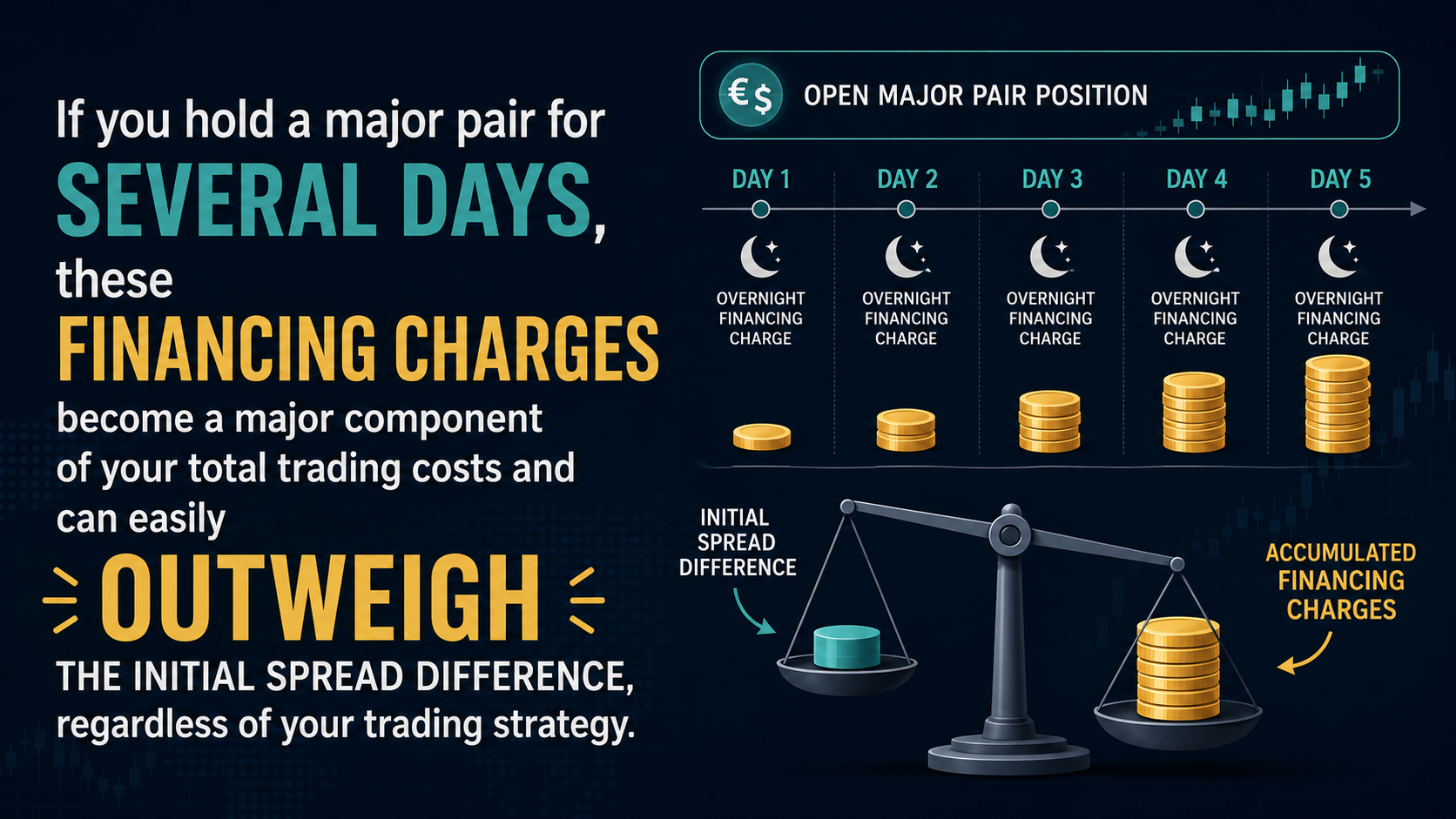
Swing traders usually have more room in their profit targets. While a 0.5-pip difference at entry matters, it is often secondary to forex swaps for positions held overnight.
Match your pricing model to your specific method rather than assuming one format always wins.
Do not ignore execution, slippage, and overnight charges
The cheapest advertised price may not produce the cheapest real trade.
Review average live spreads during the hours you trade. Check:
- Execution speed
- Potential for slippage
- Rejection policies
- Margin rules
- Forex swaps
If a broker publishes execution statistics, read the methodology behind them to understand how they define their performance.
Spreads often widen during major news, the daily market rollover, low-liquidity periods, and the weekly open. That can happen on both raw spread and no-commission accounts.
Keep in mind that a raw spread is simply a pricing model. It is not proof of deep liquidity, fair slippage, or reliable order handling.
How to choose a forex account without overpaying
You will see familiar labels such as Pepperstone Razor and Standard, FOREX.com RAW Spread, Exness Raw and Standard or Pro, FP Markets Raw, and Fusion Markets commission pricing.
These names are useful starting points, not recommendations. Availability, fees, platforms, and product terms can differ by country and can change. Verify current details on each broker’s official website before funding an account.
For U.S. traders, check that the firm is authorized through the appropriate U.S. regulator and review its status in the National Futures Association’s BASIC database. International traders should confirm authorization with their local regulator and understand client-money protections.
Forex and CFD trading carry a high risk of loss. Never skip broker due diligence just because the fees are low.
Common pricing mistakes that make a cheap account expensive
Traders make the same errors again and again:
- Comparing a minimum spread against another broker’s live average spread
- Forgetting the commission charged when the trade closes
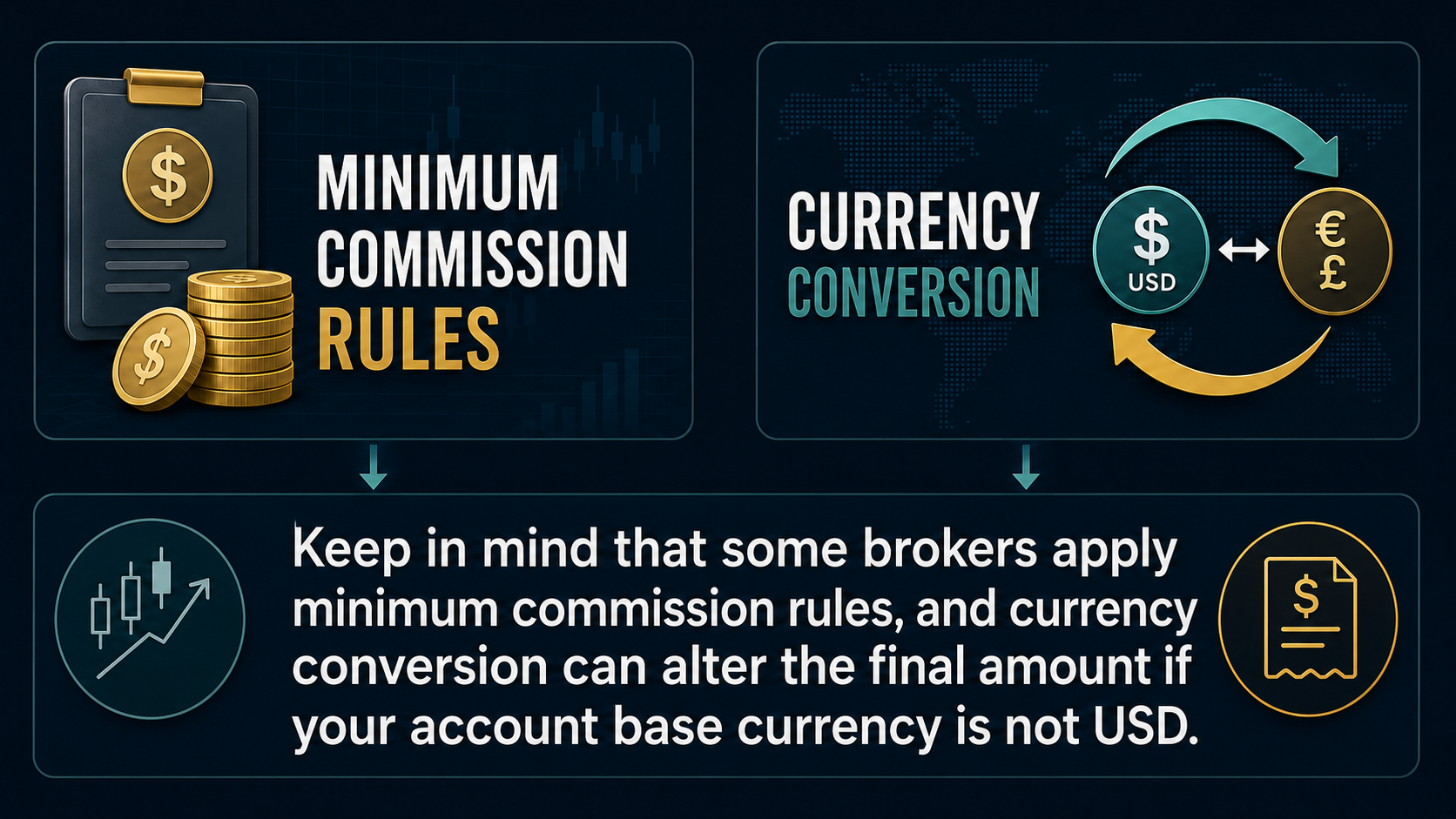
- Ignoring account-currency conversion costs
- Trading through rollover or major news without allowing for spread widening
- Overlooking swap charges on positions held overnight
- Ignoring the widening bid-ask spread during periods of low liquidity
- Choosing excessive leverage because the advertised trading cost looks low
- Selecting an offshore or poorly regulated broker only because the fee appears smaller
A lower quote isn’t useful if the broker’s conditions are weak when it really matters. Test the platform with a demo or small live position during normal market hours before committing more capital.
The bottom line: raw spread vs no commission depends on your strategy
Raw spread accounts often produce the lower all-in cost for frequent traders and those managing larger positions. Conversely, no-commission accounts can make more sense when simple pricing and a lower volume of activity are your primary priorities.
When considering raw spreads vs. no commission, the answer depends entirely on your unique trading strategy and how sensitive your portfolio is to cumulative trading costs. Remember that the account label is only the starting point.
The true factors that decide what a trade really costs are:
- Live spreads
- Commissions
- Execution quality
- Slippage
- Swap rates
- Broker regulation
Always run the round-trip calculation for your typical position size and testing conditions under ordinary market activity before selecting a broker.
FAQ
Is a raw spread account always cheaper than a no-commission account?
Not necessarily. While raw spread accounts often offer lower costs for high-volume traders, the total cost depends on the combined impact of the spread and the fixed commission. You must calculate the all-in cost for your specific position size to determine which account type is more economical.
Does a ‘zero spread’ offer mean my trading costs will be zero?
No. Brokers always collect compensation, either through a built-in markup on the spread or via a separate commission charge. Advertised zero-spread accounts often carry higher commissions or may only apply to specific currency pairs during highly liquid market conditions.
How does account type affect swing traders compared to day traders?
For day traders, tight spreads and low commissions are critical because small costs accumulate quickly over many trades. Swing traders, however, should prioritize swap rates and rollover charges, as these financing costs often outweigh minor differences in entry spreads for positions held over several days.
Is raw spread or zero commission better?
Raw spread is often better for scalpers, active day traders, and high-volume traders because tighter spreads may reduce the total cost per trade. Zero-commission accounts may suit beginners and casual traders who prefer simpler pricing.
The better option is the one with the lower combined cost after spreads, commissions, slippage, and overnight charges are included.
What’s the difference between raw spread and no commission in simple terms?
A raw spread account gives you a tighter spread but charges a separate commission for each trade. A no-commission account has no separate trading fee, but the broker usually builds its charge into a wider spread.
Simply put, you either pay the broker through a visible commission or through the gap between the buy and sell prices.
Should I choose an account based solely on the advertised spread?
Absolutely not. Advertised spreads often reflect ideal, low-liquidity conditions rather than the average live spread you will encounter. Always evaluate the total trading cost, including commissions, slippage, and swap rates, rather than focusing on a single marketing figure.
Source:: Raw Spreads vs. No Commission: Which Is Better for Forex Trading?