Key highlights:
- WTI crude price surged by 0.47% to $83.88 a barrel, while Brent gained 0.38% to $78.50 as U.S.-Iran negotiations showed little progress
- President Donald Trump said Washington is only “semi-negotiating” with Tehran and will wait for economic pressure on Iran to intensify
- Iran says there are no direct talks with the U.S. and that the Strait of Hormuz will remain closed until Washington meets its demands
Oil prices rise as U.S.-Iran talks lose momentum
Oil prices moved higher on Monday as markets reacted to the lack of a breakthrough in U.S.-Iran negotiations, raising concerns that geopolitical tensions could continue to disrupt crude supplies.
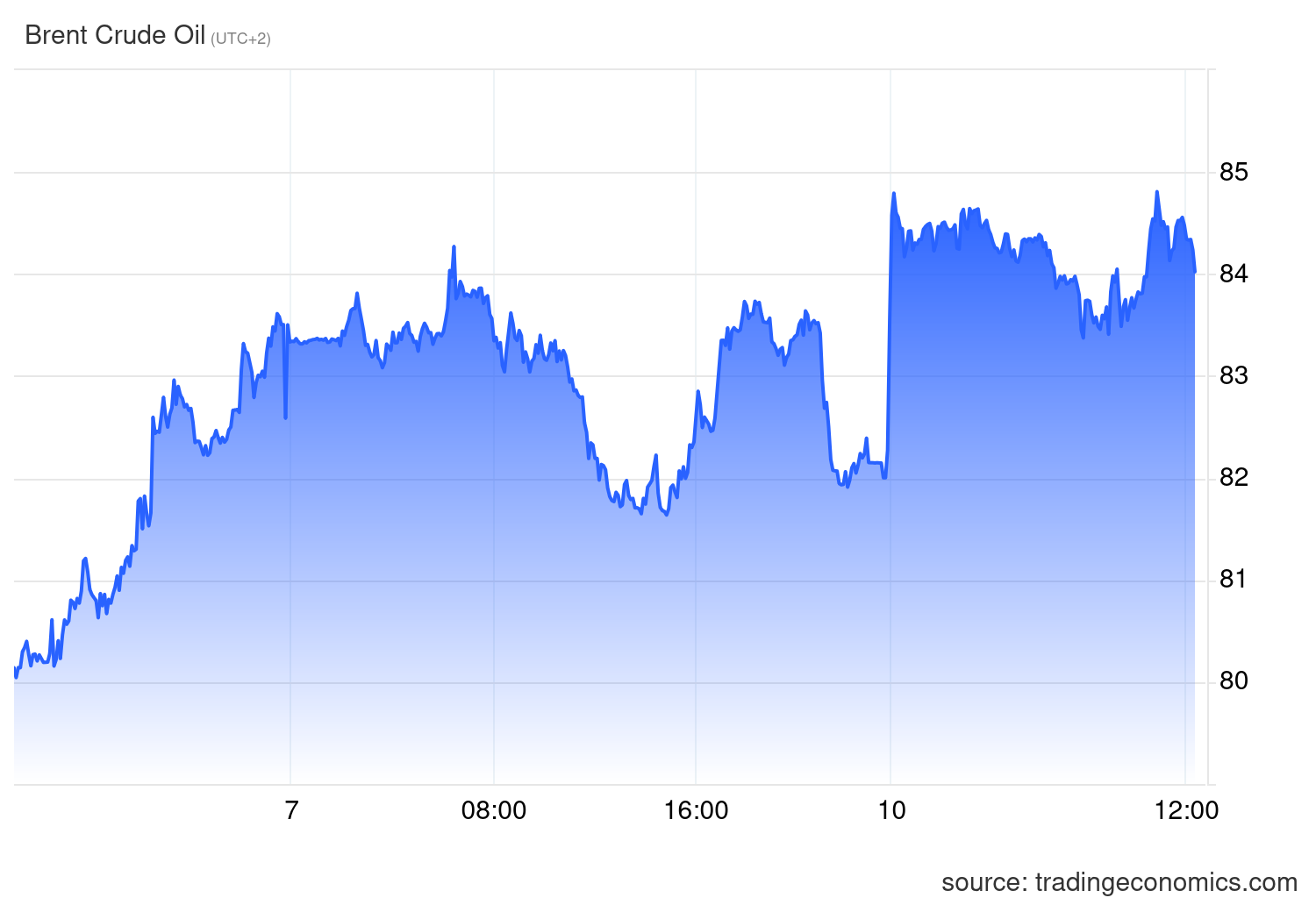
West Texas Intermediate (WTI) crude rose by 0.53% to $78.58 a barrel, while Brent crude, the international benchmark, gained 0.65% to $84.09.
Source: Trading Economics
The latest developments have reduced hopes for a quick diplomatic resolution and kept the risk premium in oil markets elevated.
Trump says U.S. is only “semi-negotiating” with Iran
The diplomatic outlook weakened after U.S. President Donald Trump said Washington is only “semi-negotiating” with Tehran.
Trump indicated that the U.S. would wait for economic pressure on Iran to mount rather than immediately pursue a full diplomatic agreement.
The comments suggest that negotiations remain far from producing a breakthrough, leaving markets to assess how long the current standoff could continue.
For oil traders, the uncertainty is particularly important because any prolonged confrontation could increase the risk of disruptions across one of the world’s most important energy-producing regions.
Iran rejects direct talks and links Hormuz reopening to demands
Iranian Foreign Minister Abbas Araghchi also signaled that there is little immediate progress toward a resolution.
Araghchi said on Sunday that there are no direct talks between Iran and the U.S. and maintained that Tehran will not reopen the Strait of Hormuz until Washington meets its demands, including lifting the naval blockade.
The development adds another layer of uncertainty to the oil market.
The Strait of Hormuz is a critical route for global energy shipments, meaning any prolonged restriction could have significant consequences for crude supply and transportation.
With Iran linking the reopening of the waterway to concessions from Washington, traders are likely to remain highly sensitive to every development surrounding the negotiations.
Geopolitical risk keeps crude prices supported
The latest diplomatic statements have reinforced concerns that the standoff could persist.
A breakthrough between Washington and Tehran could quickly ease supply fears and remove some of the geopolitical premium from crude prices. However, continued deadlock could have the opposite effect as traders price in a greater risk of prolonged disruption.
Monday’s gains remain relatively modest, but they highlight how closely oil markets are tracking developments between the two countries.
The direction of crude prices could therefore depend heavily on whether Washington and Tehran move back toward meaningful negotiations or allow economic and geopolitical pressure to intensify.
What comes next for oil prices?
As it stands, traders are watching three key factors: the progress of U.S.-Iran diplomacy, the status of the Strait of Hormuz and the potential impact of continued restrictions on regional oil flows.
If negotiations resume and both sides move toward an agreement, crude could come under renewed pressure as supply concerns ease.
However, if Trump maintains his hardline approach and Iran continues to condition the reopening of Hormuz on U.S. concessions, oil could retain a stronger geopolitical premium.
With WTI at $83.88 and Brent at $78.50, the market remains firmly focused on whether the current standoff will ease or develop into a prolonged threat to global energy supplies.
Source:: Oil Prices Rise as U.S.-Iran Standoff Deepens and Strait of Hormuz Remains Closed