
Can XRP earn passive income? Native XRP staking isn’t available on the XRP Ledger, but alternative solutions can provide access to yield.
But there is a way: Firelight XRP staking. Through Bifrost Wallet, users can access Flare’s liquid staking mechanism, which uses FXRP and issues stXRP as a receipt token. This can create a path to DeFi yield, but it isn’t direct XRP Ledger staking and returns aren’t guaranteed.
I’ll go over:
- How the process works
- What stXRP means
- What to check before you deposit funds
Let’s get into it!
Key highlights:
- XRP Ledger has no native staking rewards because it doesn’t use proof of stake, so XRP staking requires bridged assets
- Firelight uses FXRP on Flare, then gives depositors stXRP
- In the growing XRPFi space, Bifrost Wallet lets users interact with the stXRP liquid staking token, which isn’t the same asset as XRP
- Rewards, APY, liquidity, and redemption rules can change
- Smart contract, token price, liquidity, and wallet risks all matter
How to earn yield with Firelight XRP staking
Firelight is built on Flare Network, not on XRP Ledger itself. The basic path is:
XRP → FXRP → stXRP
First, the FAssets system creates the FXRP token, which represents . You cannot deposit native XRP directly into Firelight.
Once your wallet is ready, follow these steps:
- Open Bifrost Wallet and select the Browser icon to launch its built-in dApp browser
- Go to the official Firelight app and select Stake XRP. Check the website address carefully before connecting your wallet
- Read and accept Firelight’s Terms of Use and Privacy Policy if this is your first visit
- Select Connect Wallet, and then select Bifrost Wallet from the available options
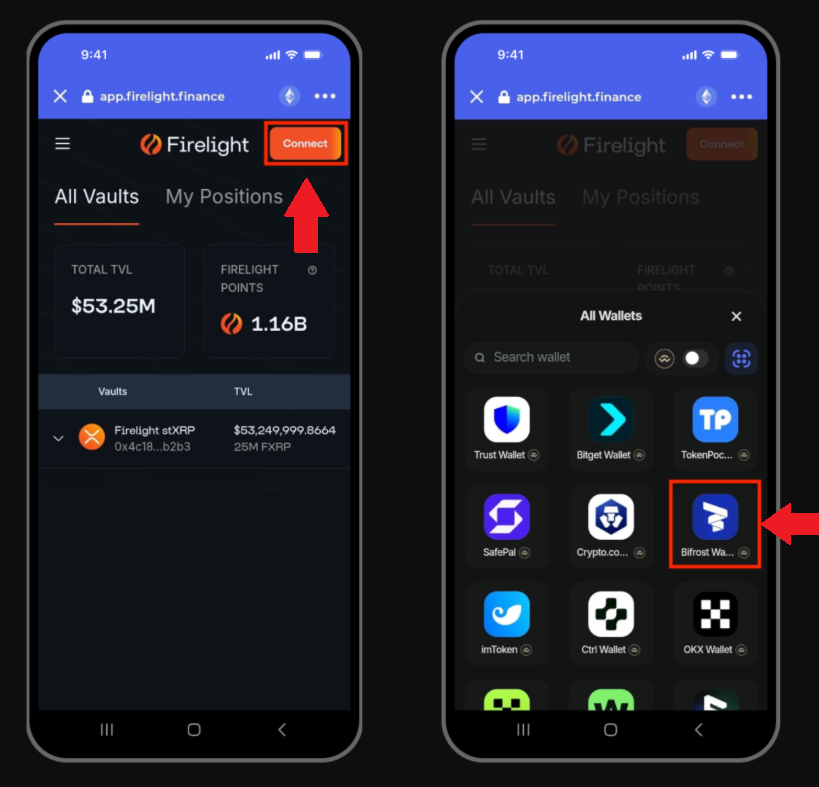
- Find the Staked XRP Vault and open its details. Review the displayed APY or rewards, total value locked, available capacity, deposit limits, and withdrawal conditions before continuing
- Enter the amount of FXRP you want to stake and select Deposit and Stake. Do not use your entire FLR balance because you will still need FLR for future transactions
- Approve the FXRP spending request in Bifrost Wallet. This transaction gives the Firelight vault permission to transfer the specified amount of FXRP from your wallet
- Return to Firelight and select Finish Staking. Confirm the second transaction in Bifrost Wallet to deposit your FXRP into the vault
After the transaction is confirmed, Firelight sends stXRP to your wallet to represent your deposited position. The launch vault issues stXRP against deposited FXRP at a 1:1 ratio, although you should always verify the live rate and vault rules before confirming.
Your rewards depend on Firelight’s current phase and terms. Check the live interface to confirm what you are currently earning.
How to withdraw your FXRP
To exit, open the vault’s Withdraw tab, enter the desired amount, and select Initiate Withdrawal. Confirm the transaction in Bifrost Wallet. Your corresponding stXRP will be burned, and the withdrawal will enter a cooldown period.
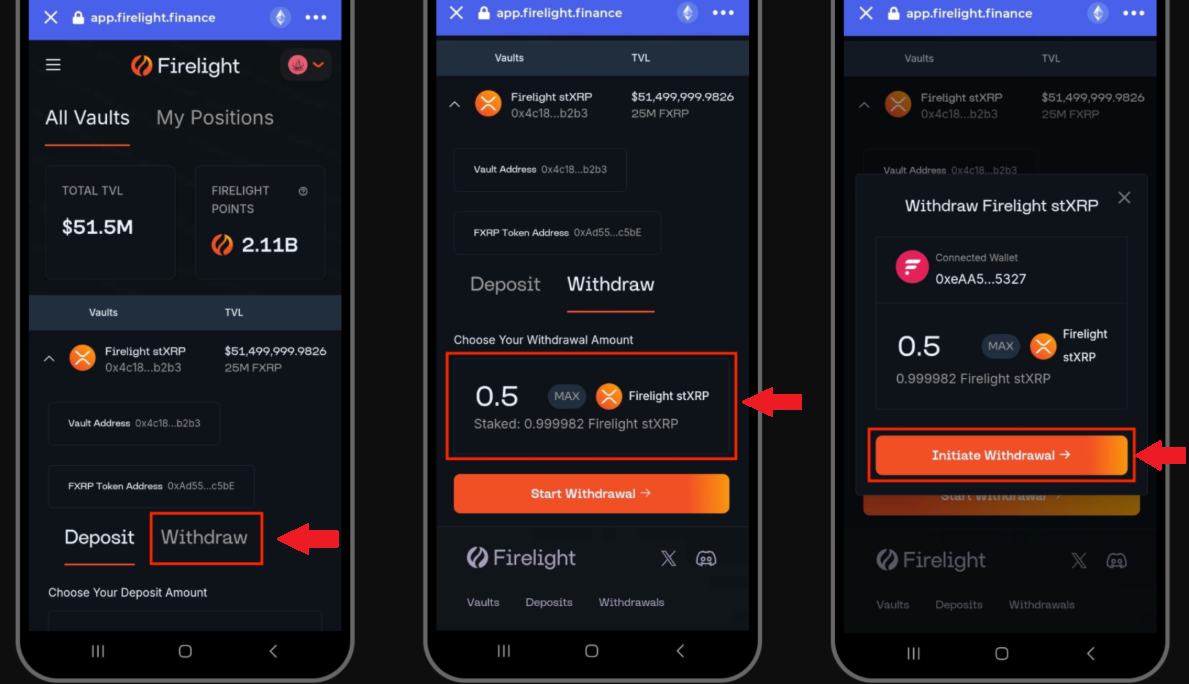
Once the completion time shown under Withdrawals has passed, return to the app and select Claim FXRP. Confirm the final transaction to receive the FXRP in the same wallet that initiated the withdrawal. You stop earning rewards on that portion as soon as its stXRP is burned.
What stXRP represents in the Firelight system
stXRP is the liquid receipt token you receive after depositing FXRP into Firelight. It tracks your position in the protocol, rather than being XRP itself.
A liquid token can be useful because you may be able to transfer it or use it in supported Flare DeFi apps. Depending on current integrations, that can include lending, liquidity pools, collateral, or other positions.
But don’t treat stXRP like cash. Its liquidity can be limited. Its market price can differ from XRP or FXRP. Its redemption process can also change.
Before depositing, check the live conversion rate, available liquidity, and exact redemption rules.
Where Firelight yield comes from and what the APY really means
APY is the estimated annual percentage return after compounding, assuming the quoted rate and conditions hold for a full year.
Firelight’s yield generation is linked to a broader DeFi protection and cover system. This includes DeFi insurance cover and Economically Secured Services. Protocol revenue may collect protocol premiums, while advanced methods such as delta-neutral strategies and options-based yield can support returns, depending on the active product and phase.
Phase 1 focused on the Launch Vault and stXRP issuance. Reward activation depends on the product’s current phase and the revenue model supporting it.
You can track available yields and reward activity in Bifrost Wallet. If incentives are active, you may claim them directly into Bifrost Wallet and swap receipt tokens through Bifrost Wallet within the wider XRPFi ecosystem.
That means you should never rely on an old APY screenshot. Confirm the live reward status in official documentation and inside the connected app before signing a transaction.
Your real result is smaller than a headline number once you include gas fees, swaps, slippage, withdrawal costs, taxes, and price movement.
High APY doesn’t guarantee safe return
A quoted yield can fall. It can also fail to offset a loss in the asset you hold.
For example, you might earn more stXRP while XRP’s dollar price falls. You could also face a discount if you need to sell stXRP before redemption and market liquidity is thin.
The biggest pressure points are usually:
- Variable protocol revenue or incentive funding.
- Changes in reward token value or reward terms.
- FXRP and stXRP price differences.
- Limited pool liquidity and delayed redemptions.
More tokens don’t automatically mean more dollars. The price, exit route, and fees decide the final result.
Some third-party material has discussed estimated returns around 4% to 7%. Treat any range like that as a rough estimate, but definitely not a guarantee.
Main risks of using Firelight protocol for XRP yield
Firelight adds smart contract and network risk to an XRP-linked position. You’re also relying on Flare, wallet approvals, FXRP mechanics, token liquidity, and the protocol’s redemption design.
An unbonding period or vault cooldown period can delay withdrawals and reduce staking liquidity. Check these terms before depositing, especially if you may need quick access to your funds.
Don’t assume onchain protection eliminates losses. Review Flare’s risk infrastructure, Firelight’s redemption design, and any stated coverage or limitations.
Use official links only. Phishing sites often copy crypto interfaces well enough to fool experienced users.
If you use Bifrost Wallet, double-check every approval prompt before signing. Even with the best crypto wallets, always verify the network, recipient, token, and transaction amount.
Keep recovery details offline and private. Never share a seed phrase, including your Bifrost Wallet recovery phrase. Read every approval request, especially approvals that allow a contract to spend your tokens.
Don’t deposit money you need for rent, bills, or a short-term purchase. Crypto yield should never force you to sell at a bad time.
Simple due diligence checklist before depositing FXRP
- Read the current Firelight documentation and confirm rewards are active
- Check the live APY source, not a social post or old promotional graphic
- Price the FXRP acquisition cost, Flare gas, deposit fee, and withdrawal fee
- Confirm the redemption time and whether liquidity is available for an early exit
- Review smart contract security audits, known risks, and the exact scope of any insurance or cover
- Verify your wallet supports Flare and keep enough FLR for gas
- Check stXRP trading liquidity and your tax-reporting obligations
Calculate the outcome after costs. A promotional APY means little if buying FXRP and exiting stXRP consumes most of the return.
Firelight vs. XRP earn accounts and lending platforms
A Firelight position is usually self-custody based. Through Bifrost Wallet, you connect your own wallet and interact with smart contracts.
That lets you maintain control while participating in XRPFi across the Flare ecosystem. It also puts transaction and wallet responsibility on you.
An XRP earn account or lending platform often uses a different model. You may give custody to a company, accept a fixed term, meet a loyalty-tier requirement, or depend on borrower demand.
Institutional lending may also involve providers such as Sentora (formerly Credora), with different credit and custody arrangements.
A higher advertised rate doesn’t mean a better option. It may simply mean more custody risk, less liquidity, a temporary promotion, or a different source of yield.
Who Firelight suits, and who should avoid it
Firelight is good if you understand Flare, FXRP, wallet approvals, and DeFi smart contract risk. Bifrost Wallet can help you access these tools without giving up direct wallet control.
You should also be comfortable with variable returns and changing liquidity. Beginners can learn with a small test amount, or wait until reward details, audits, redemptions, and documentation are easy to verify.
It’s not a fit for anyone who needs guaranteed income, instant access to every dollar, or a product with no technical risk.
How to check your real return after using Firelight
Use a simple calculation before you deposit.
Say you deposit 1,000 FXRP and the estimated annual yield is 5%. If that rate held for a year, you would receive an estimated 50 FXRP in rewards before costs. If the yield comes from delta-neutral strategies, remember that the estimate can still change.
Now subtract network fees and slippage in XRPFi, along with swap costs, deposit fees, withdrawal charges, and taxes. Then compare the dollar value of your starting position with your ending position.
This is only an example. It doesn’t account for XRP, FXRP, or stXRP price changes.
The bottom line
XRP itself doesn’t have native staking rewards. The Firelight protocol offers a separate route through FXRP on Flare and the stXRP liquid staking token.
Before depositing, check reward activation, live APY, liquidity, redemption terms, fees, and protection details. For a digital asset treasury, delta-neutral strategies may help optimize returns, while Bifrost Wallet can support fund management.
Start small and use only funds that can handle market, smart contract, custody, and liquidity risk.
Next, feel free to check out our guide on:
Best XRP Wallets for Cold & Hot Storage
Or, if you want to learn about other great coins to stake, read:
FAQ
Can I stake XRP directly on the XRP Ledger?
No. The XRP Ledger doesn’t provide native proof-of-stake rewards. Firelight uses FXRP through the FAssets system on Flare Network. So you need to understand the conversion and network steps before treating it as an XRP yield option.
Is Firelight’s estimated 4% to 7% APY guaranteed?
No. That range has appeared in third-party or promotional material, but actual returns depend on reward activation, protocol revenue, market conditions, fees, and current rules. Check the live source before depositing.
Is stXRP the same as XRP?
No. stXRP is a liquid receipt token linked to an FXRP position in Firelight. Its value, liquidity, and redemption path may differ from XRP. Any available onchain protection may also depend on the protocol’s current terms and design.
What is the safest way to try XRP yield products?
Start by comparing the yield source and the risks. Some protocols use Economically Secured Services and may work with partners such as Sentora, but protection terms can vary.
Use official links, verify contracts and protection terms, test with a small amount, and never share your seed phrase or sign a transaction you don’t understand.
Source:: Firelight Explained: How to Earn Yield with XRP Staking