Key highlights:
- Loopring will shut down its decentralized exchange after failing to achieve meaningful market share despite being one of Ethereum’s earliest layer-2 projects.
- The protocol was once viewed as a leading solution for Ethereum scaling but struggled to compete against rivals such as Uniswap, Arbitrum, and Base.
- The closure highlights how quickly the decentralized finance landscape has evolved since the DeFi boom of 2020 and 2021.
One of Ethereum’s earliest DEX pioneers is calling it quits
Loopring, one of the earliest projects to bring zk-rollup technology to Ethereum, is shutting down its decentralized exchange after years of declining relevance within the DeFi ecosystem.
The project announced that it will discontinue its DEX operations, marking the end of a platform that once stood at the forefront of Ethereum’s scaling movement.
For many early crypto users, Loopring was among the first protocols to demonstrate that Ethereum transactions could be executed faster and more cheaply through layer-2 infrastructure.
However, despite its technological innovations, the platform never managed to capture enough trading activity to compete with the industry’s dominant decentralized exchanges.
Loopring helped pioneer Ethereum scaling
Launched years before today’s layer-2 boom, Loopring gained attention for using zk-rollups to batch transactions off-chain before settling them on Ethereum.
At a time when Ethereum users routinely faced high gas fees and network congestion, the technology was viewed as one of the most promising scaling solutions available.
The protocol’s decentralized exchange allowed users to trade assets while benefiting from lower fees and faster settlement than Ethereum’s base layer could provide.
Loopring’s technology would later influence the broader adoption of zero-knowledge proofs across the blockchain industry.
Today, many of Ethereum’s fastest-growing scaling projects rely on similar concepts.
Competition ultimately proved too strong
While Loopring was an early innovator, the DeFi landscape changed dramatically over the last several years.
Protocols such as Uniswap became the dominant venue for decentralized trading, while newer ecosystems including Arbitrum, Base, Optimism, and zkSync attracted developers, liquidity providers, and users at a much faster pace.
The challenge was not necessarily the technology.
Instead, Loopring struggled to generate the network effects required to compete in a market where liquidity, user activity, and ecosystem growth increasingly concentrated around a handful of leading platforms.
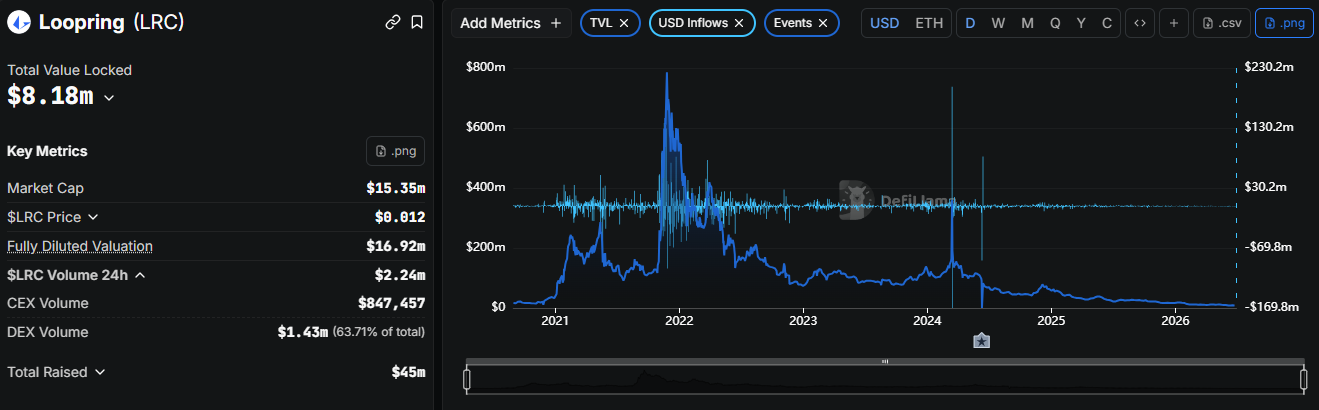
According to DeFiLlama data, Loopring’s share of decentralized exchange volume has steadily declined as traders migrated toward larger and more liquid alternatives.
The result was a gradual loss of relevance despite the protocol’s strong technical foundation.
What the shutdown says about crypto’s evolution
Loopring’s closure serves as a reminder that technological innovation alone is not always enough to guarantee long-term success.
Many of the most influential projects from previous crypto cycles have struggled to maintain relevance as the industry matured and competition intensified.
The protocol helped prove that Ethereum could scale through layer-2 technology years before the concept became mainstream. Yet the market eventually rewarded platforms that combined technology with liquidity, ecosystem growth, and user adoption.
For Ethereum, the shutdown is unlikely to have any meaningful impact on network activity. However, it represents the end of an important chapter in the history of decentralized finance for the broader industry.
Loopring helped pioneer technologies that are now widely used across Ethereum’s layer-2 ecosystem. Even if its DEX failed to achieve lasting adoption, its influence on blockchain scalability will likely outlive the platform itself.
Source:: Ethereum Pioneer Loopring Is Shutting Down Its DEX After Failing to Gain Traction