Key highlights:
- Project Eleven has developed a zero-knowledge proof system to allow Bitcoin users to recover coins frozen under the proposed BIP-361 quantum defense
- The recovery method will not work for Satoshi Nakamoto’s bitcoin stash because the coins were created before seed phrases existed
- Bitcoin’s ecosystem is also debating a proposal to ban the storage of non-financial data on the blockchain
Quantum security startup Project Eleven unveiled a zero-knowledge proof system to recover bitcoin frozen under a proposed protocol upgrade. However, the proposed system cannot recover the roughly 1.1 million BTC attributed to Bitcoin creator Satoshi Nakamoto.
Satoshi’s stash at risk as new recovery system targets frozen Bitcoin
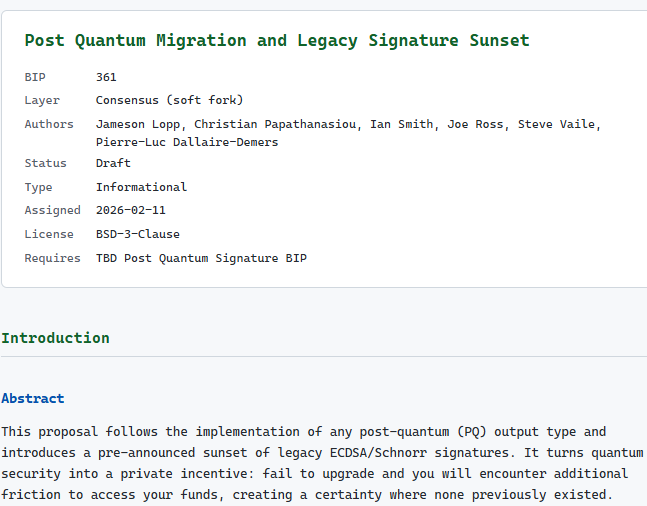
BIP-361, a Bitcoin Improvement Proposal designed to protect the network from quantum-enabled theft, has garnered significant steam. Under the
To address concerns that such a freeze will permanently lock users out of their funds, Project Eleven built a recovery mechanism using zero-knowledge proofs. The system allows wallet owners to prove they control the cryptographic material behind a vulnerable address without revealing any private keys.
According to a disclosure, the prototype generates proofs in under a second using only a CPU and verifies them in under 40 seconds, making the approach practical for consumer hardware.
Despite the breakthrough, the recovery mechanism cannot help Bitcoin’s earliest wallets. Satoshi mined Bitcoin in 2009 and 2010 before the introduction of BIP-32, the standard that created hierarchical deterministic wallets. According to some estimates, Satoshi could be holding as much as 1.1 million BTC in his wallets.
Those early wallets generated every private key independently rather than from a master seed, meaning they have no parent key that can be used to generate a zero-knowledge proof. Without that cryptographic hierarchy, there is nothing for the recovery protocol to verify.
The same limitation affected other pre-2012 Bitcoin wallets, many of which store some of the network’s oldest and most dormant coins. BIP-361 itself notes that recovery via zero-knowledge proofs depends on ownership of an HD wallet seed phrase.
BIP-361 ignites debate among Bitcoin enthusiasts
BIP-361 remains one of the most debated proposals in Bitcoin’s preparation for the quantum threat. The proposal is considered the network’s strongest attempt to prevent quantum computers from deriving private keys from exposed public keys.
Per the proposal, over 34% of Bitcoin’s supply has already revealed a public key on-chain, making those coins theoretically vulnerable to an advanced quantum computer. Experts predict that quantum computers will have the capability to breach Bitcoin’s security architecture by the end of the decade.
However, critics argue that freezing vulnerable coins is a violation of Bitcoin’s principle of permanent ownership. Meanwhile, the proposal’s supporters countered that allowing quantum attackers to steal dormant coins will pose a greater threat to the network.
BIP-361 is not the only proposal sparking debate in Bitcoin’s ecosystem. BIP-110, a proposal designed to restrict “non-monetary” like Ordinals and BRC-20 data from being stored on the Bitcoin blockchain, has threatened to splinter the ecosystem. Other blockchains are racing to quantum-proof their networks. Vitalik Buterin unveiled Lean Ethereum, while Solana and BNB Chain have rolled out initiatives to stave off the quantum threat.
Source:: Bitcoin Quantum Recovery Plan Excludes Satoshi Nakamoto's 1.1 Million BTC