Key highlights:
- BIP-110’s minority chain stalled after mining just two blocks, highlighting its lack of network-wide support
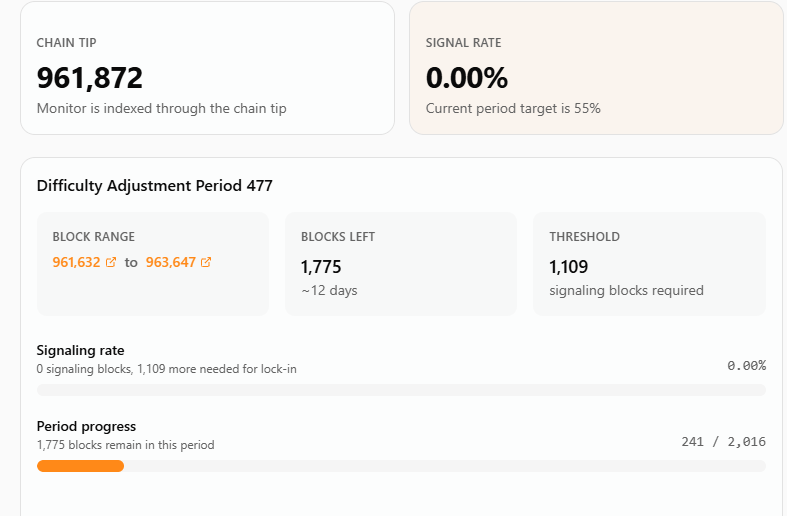
- Only around 2.53% of Bitcoin’s hashpower supported BIP-110, far below the 55% signaling threshold
- The failed bid underscores the difficulty of forcing changes to Bitcoin’s consensus without broad support from miners and the broader ecosystem
Bitcoin’s controversial BIP-110 upgrade has failed to gain meaningful support from miners, leaving its breakaway chain stalled after producing just two blocks. The episode marks a major setback for supporters seeking to force new restrictions on non-financial data through a user-activated soft fork.
BIP-110 fails to attract miners as minority chain falls apart
BIP-110, a softfork its mining operations on the BIP-110 chain over the weekend, then released a statement on Monday morning saying it will resume mining.
“We do not see this as a defeat for the BIP-110 movement but an escalation to the next step,” said Roughnecks in a statement.
Roughnecks noted that it will continue mining until a sensible Proof-of-Work (PoW) change can be implemented for the network. Already, Dathon Ohm, one of the backers of BIP-110, disclosed that the community is working on a proposal to “fire the miners,” but the exact details are still under wraps.
The failure does not mark the end of the debate that produced BIP-110. Supporters have argued that the proposal addresses concerns over the growing use of Bitcoin blockspace for inscriptions and other nonfinancial data. Meanwhile, opponents have questioned whether changing consensus rules through a minority-led activation process is appropriate.
Source:: BIP-110 Fails as Bitcoin Minority Chain Stalls After Two Blocks