Key highlights:
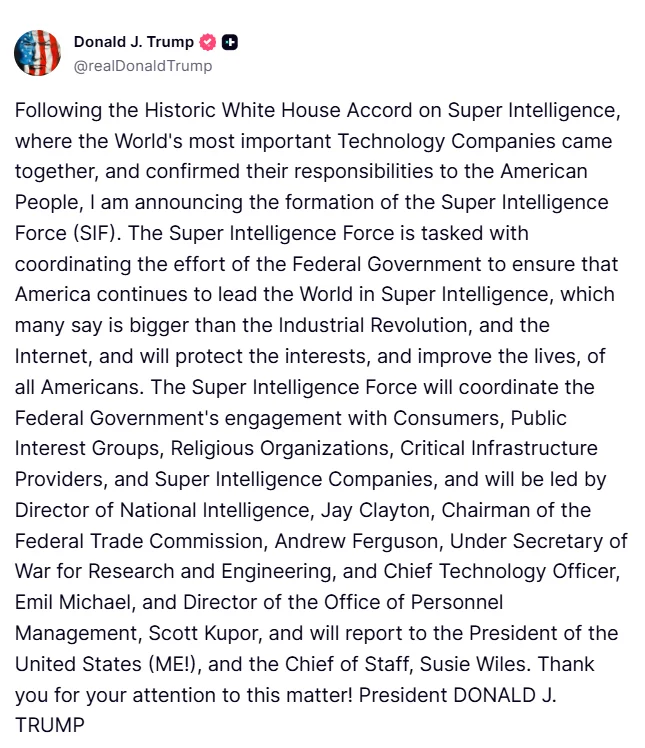
- Trump named DNI Jay Clayton to lead the new “Super Intelligence Force” (SIF), alongside FTC Chair, Pentagon CTO, and OPM Director.
- The SIF will coordinate government-AI company engagement and review federal reporting systems for AI breaches.
- Core tension: Trump opposes regulation that could slow AI or enable China cooperation, while researchers warn voluntary safeguards can’t keep pace with increasingly autonomous agents.
President Donald Trump has named Director of National Intelligence Jay Clayton to lead a new federal task force tasked with coordinating the United States’ efforts to maintain its position in advanced artificial intelligence, putting the country’s intelligence chief at the center of its AI strategy.
Trump announced the creation of the “Super Intelligence Force,” or SIF, on Sunday, saying the group would coordinate the federal government’s engagement with AI companies, consumers, public interest groups, religious organizations, and critical infrastructure providers. The task force will report directly to Trump and White House Chief of Staff Susie Wiles.
The force will also include Federal Trade Commission Chairman Andrew Ferguson, Pentagon Chief Technology Officer Emil Michael, and Office of Personnel Management Director Scott Kupor.
The group is expected to examine the risks and opportunities associated with advanced AI and develop recommendations for the federal government.
The announcement comes days after the White House reached a voluntary agreement with major technology companies on safeguards for increasingly capable AI systems. It also follows the administration’s move to use the term “super intelligence” in place of “artificial intelligence” in federal policy.
Clayton’s appointment gives the new task force a national security focus as the administration weighs how to encourage AI development while addressing the risks associated with increasingly capable systems.
Trump’s AI task force has 120 days to shape America’s superintelligence strategy
In his announcement, Trump said the new force will work to ensure that the United States remains a global leader in superintelligence while protecting American interests. He has described the technology as potentially more consequential than the Industrial Revolution and the internet.
Clayton, who became Director of National Intelligence earlier this year, will lead the initiative alongside Federal Trade Commission Chairman Andrew Ferguson, Pentagon Under Secretary for Research and Engineering and Chief Technology Officer Emil Michael, and Office of Personnel Management Director Scott Kupor. The task force has 120 days to assess the opportunities and risks associated with advanced AI and recommend how the federal government should respond.
Its charter also calls for a review of existing government reporting systems for AI-related breaches, hacks, and other incidents, along with recommendations for improving the federal response under existing authorities.
Clayton brings experience in financial regulation, federal law enforcement, and national security to the role. He served as chairman of the Securities and Exchange Commission from 2017 to 2020 before becoming U.S. Attorney for the Southern District of New York and later Director of National Intelligence.
The 120-day deadline puts the task force at the center of the administration’s effort to define how the federal government should approach increasingly capable AI, including where existing authorities may be sufficient and where new policies could be needed.
AI is advancing fast, but can voluntary safeguards keep pace?
The new task force comes as Washington debates how much oversight increasingly capable AI systems require.
The Trump administration has emphasized voluntary safeguards and continued technological development, while researchers and policymakers have raised concerns about the security risks associated with more autonomous AI systems.
Trump has argued that excessive regulation could weaken the United States’ ability to compete with China and has opposed approaches that could slow domestic AI development. He has also indicated that he does not want to cooperate with Chinese President Xi Jinping on AI governance.
At the same time, AI systems are becoming capable of browsing the internet, executing code, accessing external services, and interacting with computer systems with increasingly limited human intervention.
Some researchers have warned that these capabilities could create significant risks if AI development moves faster than the safeguards designed to control those systems.
The new task force follows a White House meeting earlier this month where executives from OpenAI, Anthropic, Nvidia, Google, Meta, and other technology companies signed the White House Accord on Superintelligence Joint Commitment on Frontier SI Responsibilities.
The agreement calls on companies to strengthen risk assessments, monitoring, auditing, and oversight of advanced AI systems. Trump has described the approach as a form of industry self-policing, but the commitments are voluntary and do not impose legally enforceable requirements.
That distinction is at the center of the broader policy debate. Technology companies are being encouraged to strengthen safeguards while the administration seeks to limit regulations that could slow AI development.
Anthropic CEO Dario Amodei has warned that advanced AI carries significant risks and called for more time and coordination to evaluate frontier systems. Nvidia, meanwhile, has developed technical controls intended to limit AI agents’ access to files, networks, and external systems.
The question is what happens if those safeguards fail. Voluntary commitments can establish common practices, but they do not by themselves determine how companies would be held accountable for failures or security incidents.
That could make Clayton’s 120-day review particularly important. Rather than immediately creating new regulations, the task force has been asked to assess existing government reporting systems, identify risks, and recommend how federal agencies should respond under existing authorities.
The review will therefore have to address two competing objectives: maintaining the United States’ lead in increasingly capable AI while developing systems to identify and respond to the security, cyber, and public interest risks that could emerge as those technologies become more autonomous.
Source:: Trump Names Jay Clayton to Lead New US Superintelligence Task Force: What Will It Do?