Key highlights:
- BIP-110 is nearing mandatory signaling as the proposal inches toward activation
- Miner support remains below 3%, far short of the 55% threshold, setting up a major dispute between miners and nodes enforcing the proposal
- A chain split is the key risk, as BIP-100 nodes could reject blocks from miners that do not signal support
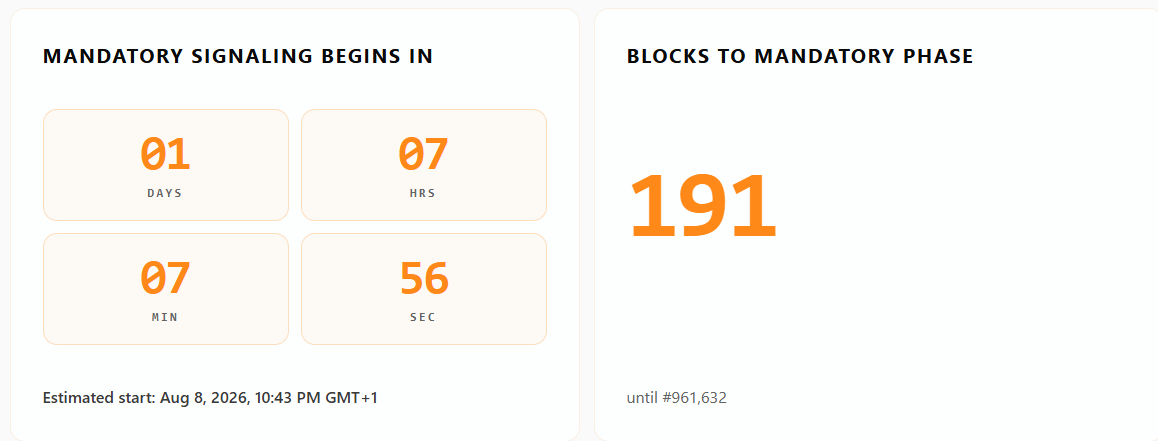
Bitcoin’s controversial BIP-110 proposal is entering a decisive phase this weekend, with mandatory signaling tipped to begin around August 9. However, support from Bitcoin miners remains far below the threshold required for a network-wide upgrade as key ecosystem players kick against the proposal.
Mandatory signaling approaches for BIP-110
BIP-110, formally titled the “Reduced Data Temporary Softfork,” seeks to temporarily restrict how Bitcoin transactions can carry arbitrary data. If
Mandatory signaling means BIP-110 stops being an optional upgrade for nodes that choose to run it. During the period, miners are expected to signal support for the proposal in their blocks, while nodes enforcing BIP-11- can reject blocks that fail to meet the proposal’s signaling requirements.
However, this does not mean the entire Bitcoin network automatically adopts BIP-110. Instead, it creates a situation where nodes enforcing the proposal can treat blocks produced by non-signaling miners as invalid, potentially creating competing chains if enough miners refuse to follow the rules.
The mandatory signaling window runs through block 963,647, with lock-in scheduled no later than block 965,648 under the proposal’s deployment rules.
Miner support remains far below the threshold
Public signaling remains nowhere near the 55% threshold required for BIP-110 to lock in through its normal activation mechanism. Recent monitoring has put miner support at roughly 2% to 3%, highlighting the gap between the proposal’s supporters and the mining industry.
The lack of support has intensified opposition from leading Bitcoin personalities. Both Adam Back and Strategy’s Michael Saylor argue that attempting to activate a consensus change without broad miner support could fragment the network and undermine confidence in the upgrade process.
BIP-11- supporters are holding on to a different view. They argue that miners do not have exclusive authority over Bitcoin’s consensus rules and that node operators and economic users can independently choose which rules their software enforces.
The disagreement is now moving from theory toward an actual network test. Ahead of the test, Bitcoin price is inching toward $65,000, remaining unfazed by the differing opinion in the ecosystem.
Source:: Bitcoin’s BIP-110 Enters Critical Phase With Miner Support Below 3%