Key highlights:
- U.S. Treasury yields continued climbing after the Federal Reserve left interest rates unchanged at 3.5% to 3.75%
- The 30-year Treasury yield climbed above 5.23%, its highest level since 2007, while the benchmark 10-year yield approached 4.70%
- Markets are now focused on upcoming inflation and labor market data for clues on whether the Fed will resume rate hikes later this year
Treasury yields extend rally after Fed decision
U.S. Treasury yields pushed higher on Thursday as investors digested the Federal Reserve’s latest policy decision and reassessed expectations for interest rates through the remainder of the year.
The benchmark 10-year Treasury yield climbed to around 4.70%, while the 30-year Treasury bond rose above 5.23%, extending its recent rally to the highest level since mid-2007. The policy-sensitive 2-year Treasury yield also has surged to approximately 4.29%, reflecting continued expectations that borrowing costs may remain elevated.
The move prolonged the recent Treasury sell-off, with bond prices falling as yields continued to climb.
Fed leaves rates unchanged in divided vote
The latest market reaction followed the Federal Reserve’s decision to keep its benchmark interest rate unchanged within a range of 3.5% to 3.75%.
The Federal Reserve held interest rates steady at 3.5%–3.75%, but the bigger story was the dissent inside the committee.
Three policymakers voted against the decision, signaling that support for higher rates is no longer limited to isolated comments outside the meeting.
Dallas… pic.twitter.com/CkRMbl7eaK
— TreasuryBonds.com (@TreasuryBonds1) July 29, 2026
The decision was approved in a 9-3 vote, highlighting growing differences among policymakers over the appropriate path for monetary policy.
In its post-meeting statement, the Federal Open Market Committee acknowledged that economic activity continues to expand at a solid pace despite ongoing uncertainty linked partly to geopolitical tensions in the Middle East.
Officials also noted that the labor market remains resilient, with employment growth keeping pace with workforce expansion and the unemployment rate remaining broadly stable.
The statement offered few signals that policymakers are ready to begin easing policy anytime soon, leaving investors searching for additional clues in upcoming economic releases.
Markets continue pricing additional tightening
Despite the Fed’s decision, many analysts believe additional interest rate increases remain possible before year-end.
Economists at Deutsche Bank continue to expect 50 basis points of additional tightening this year, forecasting two separate 25-basis-point increases at the Federal Reserve’s September and December meetings.
However, analysts noted that the bond market’s reaction may not provide much reassurance to policymakers.
Long-term Treasury yields have continued surging while forward real yields have softened, suggesting investors remain uncertain about how quickly inflation will return to the Fed’s target.
The steepening yield curve also raises questions about the broader economy, particularly interest-rate-sensitive sectors such as housing, where higher borrowing costs could continue weighing on demand.
Inflation data takes center stage
Attention now shifts to a fresh batch of economic data that could shape expectations for the Fed’s next move.
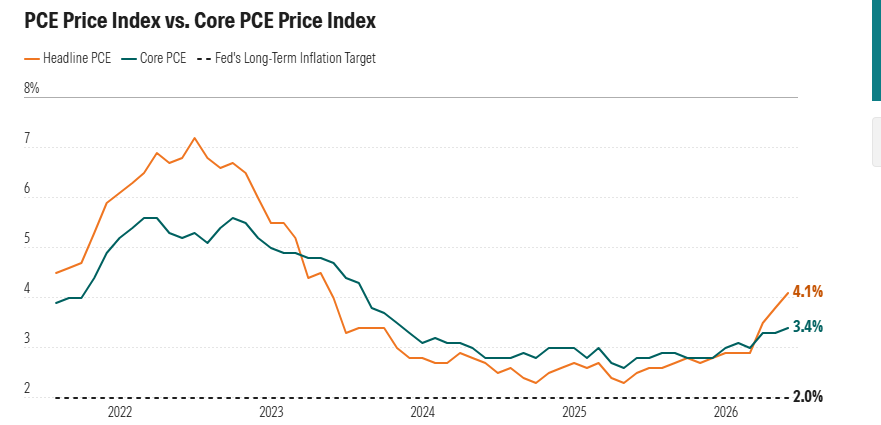
Investors are closely watching the latest weekly jobless claims figures alongside the release of the Personal Consumption Expenditures (PCE) Price Index, the Federal Reserve’s preferred inflation gauge.
Economists expect headline PCE inflation to rise 4.1% year over year, while core PCE (which excludes food and energy prices) is projected to increase by 3.4%.
Stronger-than-expected inflation data could reinforce expectations for additional rate hikes and place further upward pressure on Treasury yields. Conversely, softer readings may ease concerns that policymakers will need to tighten monetary policy further.
As it stands, bond markets remain under pressure as investors balance resilient economic growth, persistent inflation risks and uncertainty surrounding the Federal Reserve’s next policy move.
Source:: Treasury Yields Surge After Fed Holds Rates Steady in Split Vote