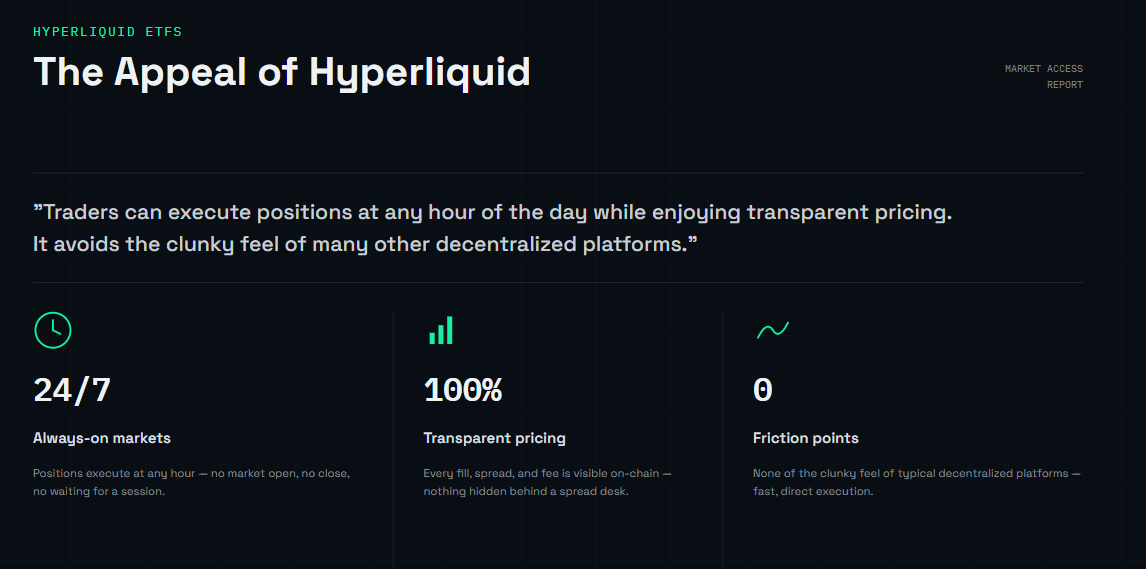
Want exposure to the , managing seed phrases, or complex on-chain setup.
While this does not remove market risk, it certainly eliminates the friction of managing digital assets directly.
As of July 2026, here are the most relevant Hyperliquid ETFs:
| Product | Hyperliquid ETF Ticker | Market | Structure | Fee | AUM |
| 21Shares Hyperliquid ETF | THYP | US | Spot ETF | 0.30% | $75.8M |
| Bitwise Hyperliquid ETF | BHYP | US | Spot ETF | 0.34% | $71.14M |
| Grayscale Hyperliquid ETF | HYPG | US | Spot ETF, staking-enabled | 0.29% | $4.5M |
| 21Shares Hyperliquid ETP | 21HY | Europe | ETP | 2.50% | EUR25M |
U.S. buyers now have three listed ETF options, while European investors have had access longer through ETPs such as 21HY. Europe also has other wrappers, including staking-focused products from CoinShares and a Hyperliquid ETN from VanEck.
Spot exposure, staking exposure, and leveraged exposure explained simply
Most buyers want a spot Hyperliquid ETF to gain direct market participation. And because these funds are available through your brokerage account, they are built to follow HYPE price movements as closely as possible.
Staking-linked exposure adds another layer to this dynamic. With a Hyperliquid staking ETF, your returns may differ from a plain spot product.
That can help in calm markets, but it also adds product complexity.
Leveraged exposure is a different animal. It tries to multiply daily moves, and that can quickly get messy. For long-term investors, simple is often better.
Why investors are paying attention to HYPE right now
HYPE is tied to a platform that has seen rapid growth, posting heavy activity while attracting significant institutional interest. This momentum keeps pulling attention from both crypto native users and traditional fund issuers who are eager to capitalize on the utility of the HYPE token.
If the venue grows, demand for the token and the funds tracking it can grow with it.
The token economics behind HYPE
The basic case is easy to follow. HYPE has roles tied to governance, staking, fee discounts, and ecosystem incentives. The project’s Hyper Foundation oversees the Assistance Fund, which helps structure the network and explain why the token sits near the center of the ecosystem.
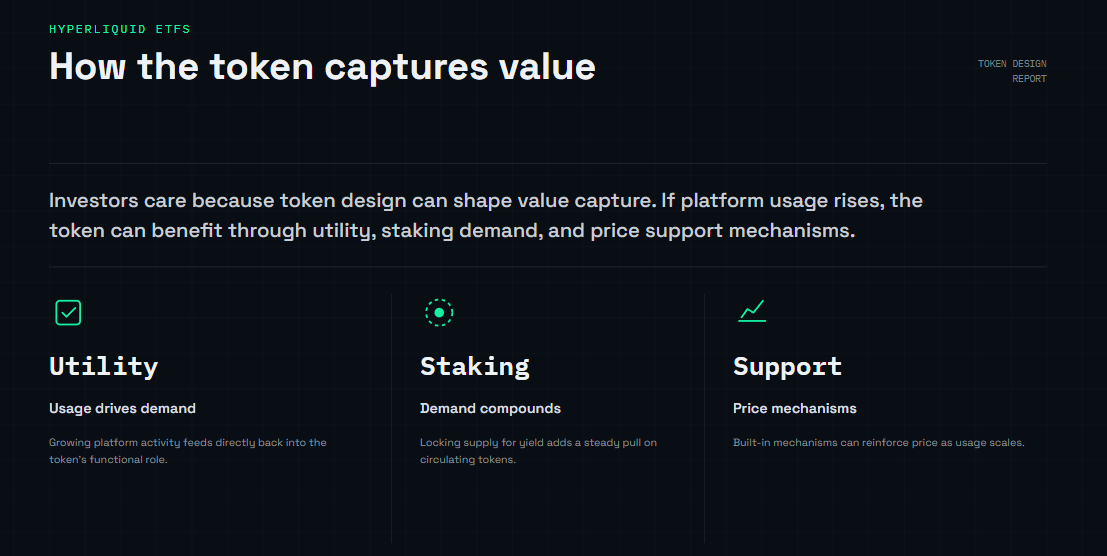
Specifically, traders often watch the token burn rate and automated HYPE buybacks as key indicators of supply pressure that may influence long term value.
What recent Hyperliquid ETF flows and market interest say about demand
The fund launches were not ignored. Hyperliquid ETF inflows amounted to $50 million in their first week, and cumulative net inflows climbed to roughly $153 million in a little over a month. On one strong day, two U.S. listed spot funds added $25.5 million.
That’s real demand.
Still, first week excitement doesn’t always last. Early inflows can cool, and newer crypto funds often trade on momentum before they settle into a steadier investor base.
What to know before buying a Hyperliquid ETF
A Hyperliquid fund may look simple on your brokerage screen, but the underlying details ultimately decide your results.
Fees, tracking, and fund size can change your results
Lower fees help over time, but you should look beyond the surface. When comparing Hyperliquid ETFs:
- THYP charges 0.30%
- BHYP charges 0.34%
- HYPG charges 0.29%
While HYPG is the cheapest on paper, fund size and trading volume are equally important factors. A higher trading volume generally leads to better liquidity, which reduces the cost of execution.
Whether you are looking at a spot Hyperliquid ETF or another derivative-based wrapper, bigger funds usually trade more smoothly. Newer or smaller funds can work well, but you should always check how closely they track the price of HYPE and how easy they are to buy or sell during market volatility.
Regional access matters, especially for U.S. and European investors
U.S. investors have the easiest path through domestic ETFs. European investors may see different wrappers, tax treatments, and exchanges, including XETRA or SIX.
These ETFs are generally available through any standard brokerage account that provides access to major stock exchanges. There are typically no special account requirements, though your regional eligibility may dictate which specific tickers are purchasable.
The biggest risks are price swings, whale moves, and platform age
HYPE is still a crypto asset. It can move quickly in both directions, and selling by large holders can hit the price quickly.
While the platform boasts impressive sub-second settlement times that provide an edge in fast-moving markets, remember that this non-custodial infrastructure is newer than established networks like Bitcoin and Ethereum.
Fast growth is exciting, but newer systems inherently carry more uncertainty. A familiar fund wrapper does not remove crypto risk.
The bottom line
Hyperliquid ETFs provide a straightforward bridge to the HYPE token. Investors gain exposure to a leading on-chain trading venue without navigating the complexities of the platform directly.
The main appeal is simplified access to digital assets.
While the opportunity is significant, remember the risks involved in volatile markets. If the network continues to scale its presence across crypto and real world market sectors, these funds will likely remain a focal point for many portfolios.
For the best results, always compare fees, liquidity, product structure, and regional access requirements before you decide to buy.
Frequently Asked Questions
Are Hyperliquid ETFs just as safe as owning the HYPE token directly?
While ETFs remove the technical risks of managing crypto wallets and seed phrases, they do not eliminate market volatility.
You are gaining exposure to the same underlying asset. So you still face the potential for significant price swings and platform-specific risks that affect the HYPE token.
Can I use these ETFs to stake my HYPE for rewards?
Most standard spot ETFs do not allow you to participate in individual staking activities. However, some specific funds like HYPG are structured to capture staking-related income on your behalf, though this often introduces added complexity and different fee structures compared to a simple spot holding.
Why should I choose an ETF instead of just trading on the Hyperliquid platform?
The primary benefit of an ETF is convenience. It allows you to gain exposure through a traditional brokerage account without needing to learn about crypto bridges or handle self-custody.
It’s great for investors who want to participate in the ecosystem’s growth without the operational burden of managing on-chain assets.
What happens to my investment if the Hyperliquid platform experiences downtime?
Because the ETF tracks the price and performance of HYPE, platform outages could negatively impact the token’s market value and, consequently, your fund’s performance.
While the fund remains a regulated financial product, it’s fundamentally tethered to the health and operational success of the underlying decentralized exchange.
Source:: Hyperliquid ETFs: A New Way to Invest in the Leading Decentralized Trading Venue