Key highlights:
- Polymarket has restructured its business, cutting employees and terminating contractor agreements as it prepares for its next growth phase
- The restructuring follows a loss of market share to rival Kalshi, intensifying competition between the two prediction market platforms
- Polymarket has appointed several senior executives, including a former Amazon finance chief, as it strengthens its leadership and institutional operations
Prediction market platform Polymarket has laid off employees and terminated several contractor agreements as part of a company-wide restructuring aimed at preparing the business for its next phase of growth. The changes come as the company faces intensifying competition from rival Kalshi, which has overtaken it in monthly trading volume.
Polymarket slashes headcount as part of company-wide restructuring
Polymarket confirmed the restructuring on November 11, following reports that an internal email notifying contractors of their termination had circulated on social media. Per the email, Polymarket informed some contractors that their agreements with the company would end effective November 4, 2026.
The restructuring reportedly affected teams involved in marketing, creative production, video, and growth. The company declined to disclose the total number of employees and contractors affected by the cuts.
However, a person familiar with the matter disclosed that contractors accounted for more than 50% of those affected. In a statement, Polymarket said the changes followed its expansion and recent leadership appointments.
“As we’ve grown and brought on new leadership, we’ve reorganized to set the company up for its next phase of growth, which has meant a lot of new hires, changes in personnel and letting some people go.”
Back in October, Polymarket fired its CMO Matthew Modabber after an internal probe revealed that he was involved in illicit activity involving the creation of fake webpages.
Kalshi pulls ahead in prediction market competition
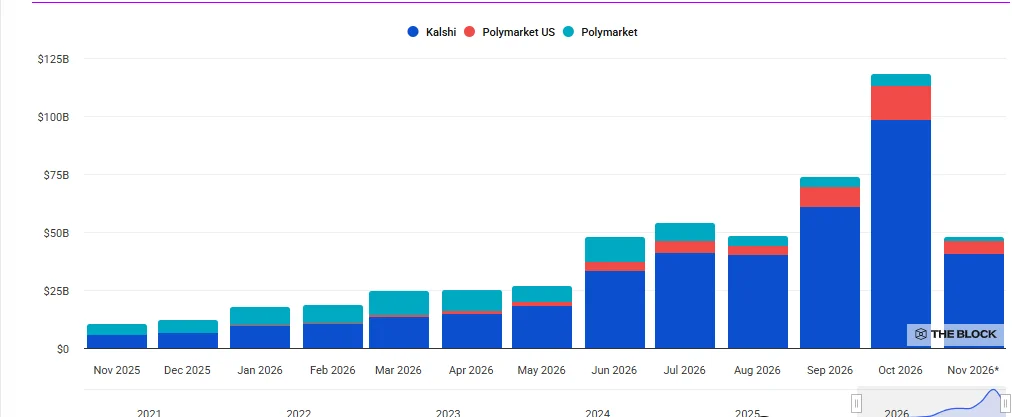
The restructuring comes as Polymarket attempts to regain ground against Kalshi, which has strengthened its position through distribution agreements and commercial partnerships.
According to data aggregators, Kalshi has overtaken Polymarket in monthly trading volume. A close look at the numbers shows Kalshi accounted for about 73% of prediction market trading volume in the third quarter, compared with Polymarket’s 18%.
Kalshi also secured a $1 billion funding round in October, co-led by Sequoia Capital and Wellington Management, at a $40 billion valuation.
Despite the competitive pressure, Polymarket has reported significant business growth. The company told CNBC that its annualized revenue had exceeded $1.8 billion as of November 2026.
New leadership signals a shift toward institutional growth
Polymarket’s restructuring follows several senior executive appointments as the company seeks to strengthen its management structure and operations. In September, the company appointed Warren Jenson, a former finance executive at Amazon, Electronic Arts, and Delta Air Lines, as its first chief financial officer.
It also brought in former Uber executive Travis VanderZanden as chief growth officer. Other appointments include former Goldman Sachs executive Lisa Mantil as head of institutional growth and former Meta executive Malea Otranto as global head of trust and safety. As part of plans to claw back market share, the company hired ex-Zora CEO Jacob Horne to rebuild Polymarket DeFi. Polymarket CEO Shayne Coplan noted that Horne will work directly with him on the project, with a keen focus on making “Polymarket DeFi great again.”
Source:: Polymarket Restructures with Layoffs and Contractor Cuts as Competition with Kalshi Intensifies