If you’ve recently encountered the AROS crypto project, also known as American Reserved Oil Supply, the safest course of action is to stay away.
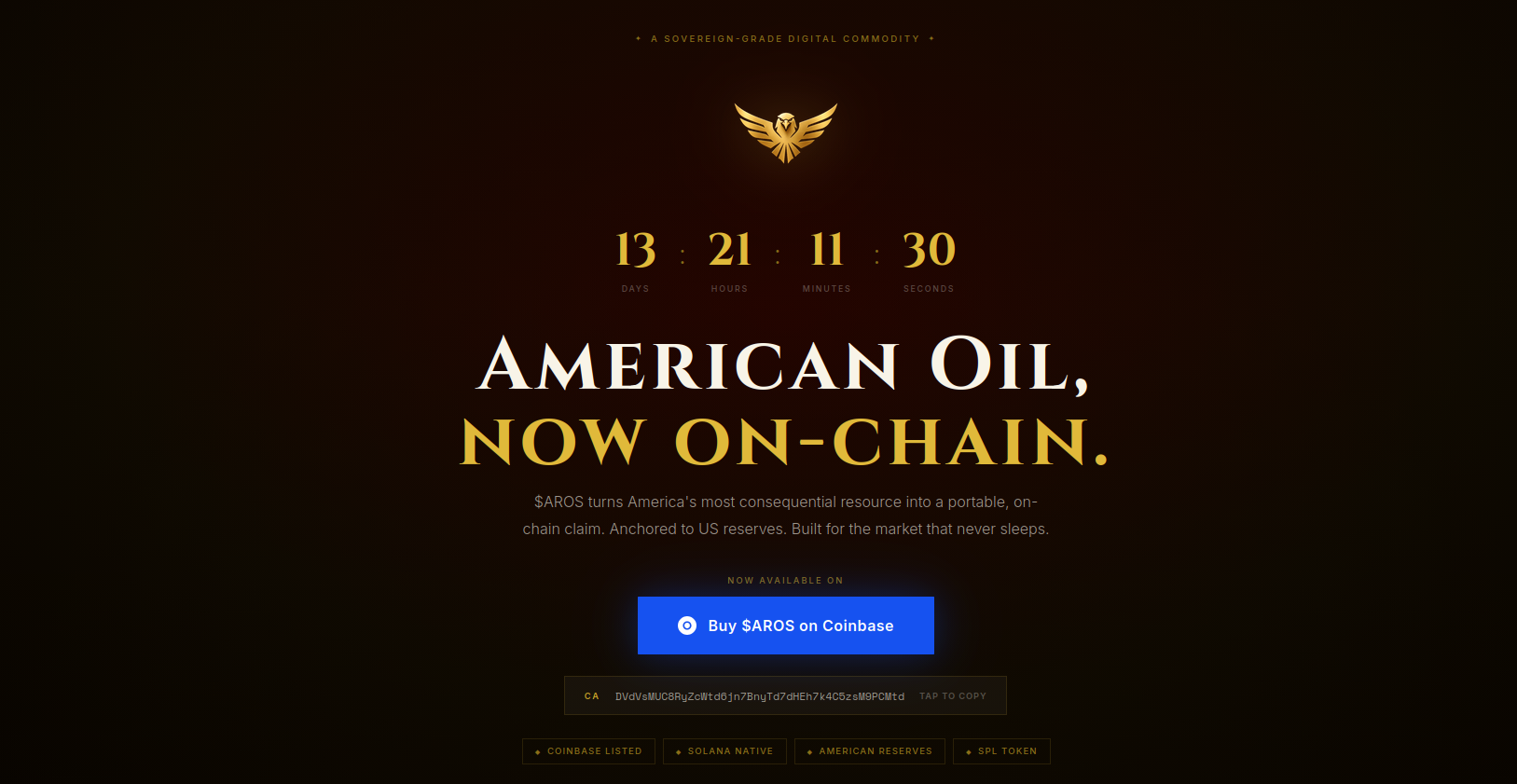
AROS has virtually all of the characteristics associated with a recurring series of highly suspicious crypto projects that have ended in rug pulls. The formula is remarkably similar: create a professional-looking website, attach the token to a politically or economically relevant narrative, imply that it has backing from a valuable real-world asset, claim legitimacy through a major platform such as Coinbase, and use a countdown or upcoming event to pressure investors into buying before they supposedly miss out.
In the case of AROS, the project claims that its token is somehow “anchored” to U.S. oil reserves. However, the supplied material does not explain any mechanism showing how AROS is actually connected to those reserves or what rights token holders receive.
Even more concerningly, the American Reserved Oil Supply website repeatedly claims that AROS is listed directly on Coinbase. According to Coinbase’s own AROS page, however, the token is not available for trading on the exchange.
Taken together, these aren’t minor warning signs. They strongly suggest that AROS is another token following a well-established rug-pull playbook.
What is the American Reserved Oil Supply crypto?
American Reserved Oil Supply crypto presents itself as a and WOFI crypto are a few recent notable examples, but there have been dozens more.
That does not mathematically prove that AROS will follow exactly the same path.
When a new copies the same marketing strategy, website style, branding approach and urgency tactics seen in projects that ended in rug pulls, investors should take that pattern seriously. The similarities aren’t superficial, and the underlying formula is the same:
- Take a narrative people already recognize
- Create a token around it
- Make the project appear more official than it really is
- Suggest backing or financial rights that are difficult to independently verify
- Use a well-known company or institution to create an impression of legitimacy
- Add a future event to generate urgency
- Encourage investors to buy before the supposed catalyst arrives
- Sell off the tokens once there is enough liquidity to make a substantial amount of money, crashing the price in the process
Is AROS crypto legit?
Anyone searching “is AROS crypto legit” should approach the token with extreme skepticism. Technically, AROS can exist as a cryptocurrency token while the claims surrounding it remain misleading or unsupported. The much more important question is whether the American Reserved Oil Supply story holds up.
The token claims to be connected to American oil reserves, but there is no clear explanation of how that connection works.
The project says AROS is listed directly on Coinbase, while Coinbase reportedly says the token is not available for trading.
The website uses a countdown to create urgency.
And the entire setup closely resembles a series of other projects that ultimately ended as rug pulls.
None of these facts inspire confidence.
Taken together, it’s very likely that the AROS crypto project is a scam.
The supposed oil backing doesn’t stand up to scrutiny
AROS marketing relies heavily on the idea that energy represents something more tangible and dependable than conventional financial assets.
The website says:
“You cannot print a barrel. Every other asset is a promise — energy is the settlement layer.”
It then claims AROS turns that idea into something “tradable, liquid, and permissionless.”
The language sounds impressive.
But it doesn’t explain anything.
If the project is genuinely backed by or connected to oil, investors should be able to identify the contracts, custodians, legal entities and reserve documentation that make this possible.
Without that evidence, the project’s oil narrative is just a story attached to a token.
The existence of America’s Strategic Petroleum Reserve does not automatically give AROS any value.
The fact that oil is scarce does not give AROS any ownership rights.
And mentioning a valuable government-controlled asset does not establish a legal relationship with it.
How to investigate AROS before buying
Anyone still considering buying American Reserved Oil Supply coin should independently verify every major project claim.
The AROS roadmap appears ambitious, but making promises is easy (especially when the team behind the token is completely anonymous).
Start with the supposed oil backing.
Look for the legal entity that owns or controls the assets allegedly connected to AROS. Verify who operates that company, where it is registered and what contractual arrangement gives it access to American oil reserves.
Then look for independent audits and custody documentation.
If the project cannot produce credible evidence showing exactly how the token is backed, assume that it isn’t.
Next, verify the AROS Coinbase claim directly on Coinbase.
Do not rely on a button on the AROS website.
Check whether AROS is actually available through Coinbase’s normal trading interface. A price-tracking page does not count as an exchange listing.
Finally, examine the token itself using reputable Solana explorers and analytics tools. Look at liquidity, holder concentration, trading volume and the largest wallets.
And don’t connect your wallet to an unfamiliar website merely because the project tells you that’s the “safe” way to buy.
The bottom line
American Reserved Oil Supply looks very likely to be another scam token following a familiar rug-pull formula.
The available evidence stops short of proving that the developers have committed fraud or that an AROS rug pull will definitely occur.
But the distinction is unlikely to matter much to investors if they buy a token whose value later collapses.
AROS claims a connection to valuable U.S. oil reserves without providing a clear mechanism explaining that relationship.
It claims to be listed directly on Coinbase even though Coinbase reportedly says the token is not available to trade.
It uses countdown-based marketing to create urgency.
And its overall presentation closely matches previous projects that used essentially the same strategy before ending badly for buyers.
AROS is also not AROS stock, and searches for an AROS stock price refer to a speculative cryptocurrency rather than equity in a conventional company.
Investors should not give a project like this the benefit of the doubt.
Until American Reserved Oil Supply provides independently verifiable evidence establishing its oil backing, legal structure, token-holder rights and exchange relationships, the most reasonable interpretation is that AROS is very likely another scam or rug-pull token dressed up with oil-themed, institutional-looking marketing.
Don’t buy it.
Source:: Don't Buy AROS Crypto: American Reserved Oil Supply Is Very Likely Another Scam