Key highlights:
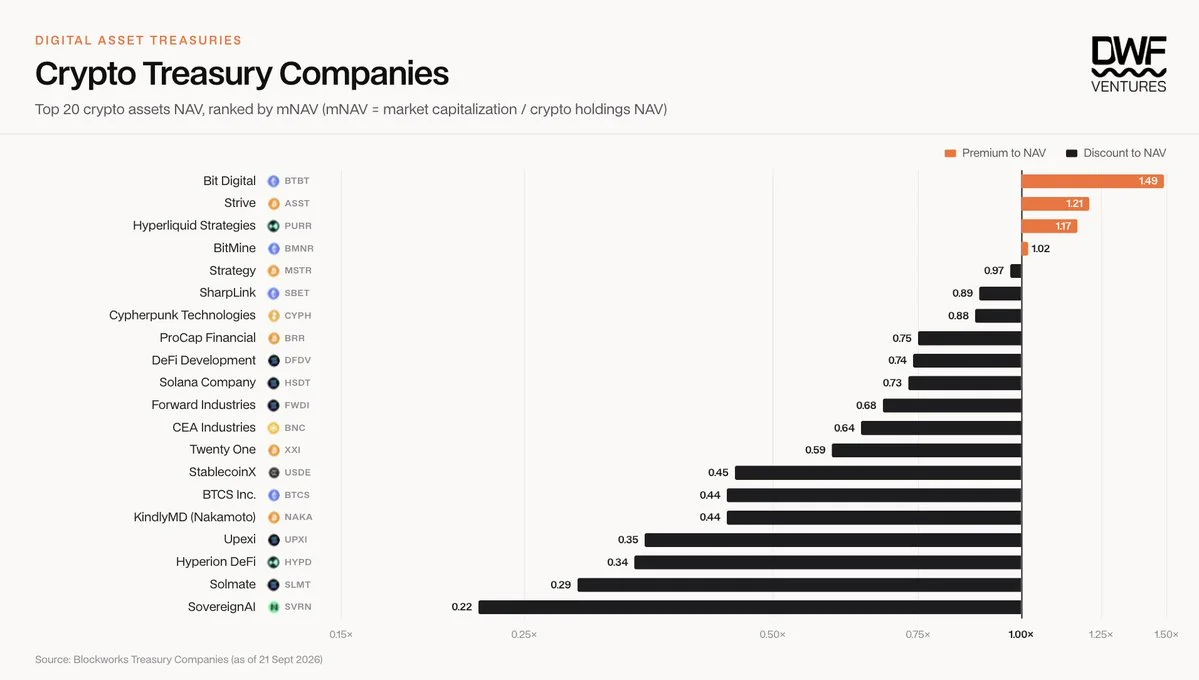
- Only 4 of the 20 largest digital asset treasury companies now trade above a market-to-NAV of 1x, ending the premium-driven flywheel
- The DAT market has grown to $180B+, but directly holding crypto has generally outperformed owning treasury company shares long-term
- Strategy remains the outlier, up 31%+ in the past month despite slowing BTC purchases, while others are pivoting to acquiring profitable businesses alongside their crypto accumulation strategies
The digital asset treasury (DAT) boom is facing a tougher test as most publicly listed companies holding large crypto reserves now trade below the value of the assets on their balance sheets, according to a report from DWF Ventures.
The shift marks a sharp change from the peak of the treasury boom, when companies could attract investors by announcing plans to accumulate Bitcoin, Ether, and other digital assets.
The model depended partly on companies trading at a premium to the value of their crypto holdings.
With more DAT stocks now trading below the value of their underlying crypto reserves, that mechanism becomes harder to sustain.
Raising capital through new shares can become less attractive because existing shareholders face greater dilution without the market necessarily assigning a higher value to the company’s crypto holdings.
The DAT model is under pressure as treasury stock premiums disappear
According to DWF, that cycle is now becoming harder to sustain, as they found that only 4 of the 20 largest digital asset treasury companies by assets under management currently trade above a market-to-net-asset value (mNAV) of 1.
An mNAV above 1 means a company is valued at more than the market value of its crypto holdings, while a figure below 1 indicates that its shares trade at a discount to those assets.
That premium was central to the DAT model. Companies could issue shares at valuations above the value of their crypto holdings, use the proceeds to purchase more tokens, and potentially increase the amount of crypto backing each share.
Once the premium disappears, that cycle becomes much harder to sustain. Issuing new shares while the stock trades below the value of its underlying assets can raise less capital relative to the crypto being acquired and may increase dilution for existing shareholders.
The pressure comes despite the sector’s rapid expansion. DWF Ventures estimates that the digital asset treasury market is now worth more than $180 billion, having grown by about 70% annually on average since 2020. Much of that growth accelerated in 2025 as smaller companies began adopting crypto treasury strategies.
The model gained wider attention after Strategy, formerly MicroStrategy, made its first Bitcoin purchase in August 2020 and gradually built its corporate strategy around accumulating the asset.
However, DWF Ventures found that directly holding the underlying crypto has generally produced stronger long-term performance than owning shares of most treasury companies.
That does not mean DAT stocks cannot outperform their underlying assets. Several have done so over shorter periods as crypto prices recovered and discounted valuations improved.
Since July, DWF Ventures said some treasury stocks, including PURR and CYPH, have outperformed their underlying tokens by 15% to 40%.
The firm attributed much of those gains to changes in market sentiment and valuation rather than a sustained increase in the amount of crypto held per share.
That distinction is becoming increasingly important for the DAT model. When investors are willing to pay a premium, companies can use their stock as a financing tool to accumulate more crypto. When that premium turns into a discount, the same mechanism becomes significantly less effective.
Strategy keeps buying Bitcoin as crypto treasury stocks lose ground
Beyond the broader selloff in crypto treasury stocks, the market is also questioning whether corporate Bitcoin strategies are delivering the stock market gains investors initially expected.
A Financial Times analysis found that more than $80 billion has been wiped from the value of Bitcoin treasury companies since mid-2025.
The combined market capitalization of the 50 companies holding the most Bitcoin fell from about $150 billion in July 2025 to $67 billion, showing the sharp decline in investor valuations across the sector.
Strategy remains the largest and most prominent example of the model, but its Bitcoin purchases have become less consistent in 2026.
The company paused purchases for about 10 weeks before resuming on Aug. 31 with a $370 million purchase of 4,603 BTC.
After another roughly two-week pause, Strategy bought 950 BTC for about $75.7 million between Sept. 14 and Sept. 20, according to an SEC filing.
The latest purchase lifted its holdings to 846,000 BTC, acquired for about $63.8 billion, at an average price of $75,416 per Bitcoin.
Strategy has also sold Bitcoin four times this year, raising about $218.4 million to strengthen its cash reserves for dividend payments.
Despite the slower pace of accumulation, Strategy’s stock has gained more than 31% over the past month and was trading above $161, showing that its share price performance has not moved in lockstep with the broader weakness across Bitcoin treasury companies.
What happens when crypto treasury companies can no longer rely on rising shares?
The pressure is forcing crypto treasury companies to look beyond rising share prices and build businesses that can generate cash flow alongside their digital asset holdings.
Some firms are pursuing operating businesses that can provide recurring revenue to support future crypto purchases. Twenty One Capital, for example, is looking to acquire profitable companies, combining its Bitcoin accumulation strategy with businesses that can generate cash flow.
DWF Ventures said this shift could become more important as the access premium once associated with DAT companies has weakened.
Investors now have more ways to gain exposure to digital assets through ETFs, regulated funds, custodians, and direct ownership.
That makes it harder for treasury companies to justify higher valuations based solely on the crypto assets they hold.
The way companies finance their purchases is also creating a wider gap in valuations. Bit Digital and Strive have continued to pursue aggressive asset accumulation and equity financing, while companies with more passive strategies have faced deeper discounts relative to the value of their holdings.
The problem becomes more pronounced when a company’s market value falls below the value of its underlying crypto assets.
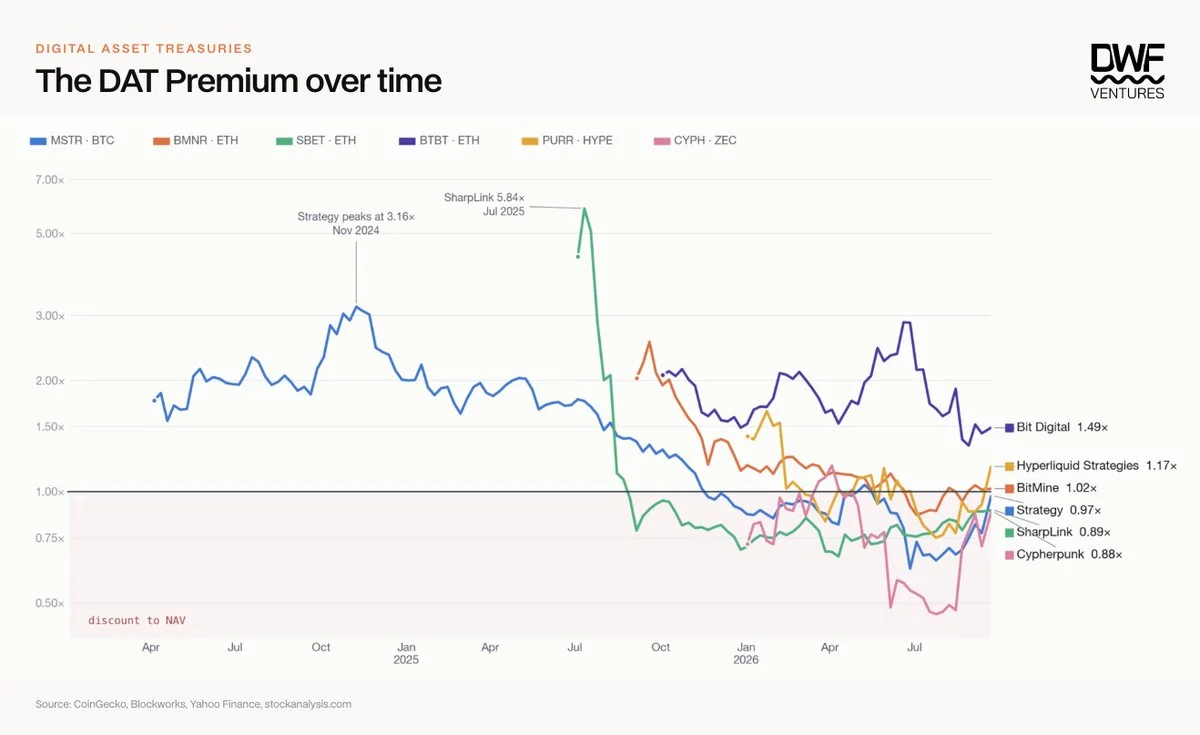
When mNAV drops below 1, issuing new shares can become less effective because the company may be raising capital at a discount to the assets it is trying to accumulate.
Instead of increasing the amount of crypto backing each existing share, new issuance can dilute shareholders.
Other financing methods can also create additional obligations. Convertible debt, preferred stock, and similar instruments can provide capital for further purchases, but they can also add interest, dividend, or repayment commitments while the value of the underlying crypto assets remains volatile.
This leaves treasury companies with a different challenge from the one they faced during the sector’s rapid expansion.
Instead of simply using a rising share price to finance more crypto purchases, companies increasingly need to demonstrate how their assets, financing structure, and underlying businesses can support shareholder value.
DWF Ventures expects more treasury companies to emerge as crypto sentiment improves, but its analysis suggests investors are becoming more selective about which models can continue to attract capital.
Source:: Crypto Treasuries Lose as Most Firms Trade Below Holdings Value: DWF