Key highlights:
- Tether declined to seek a MiCA license primarily due to the rule requiring major stablecoin issuers to hold 60% of reserves in bank deposits
- The ECB now wants the rule removed because large bank deposit requirements create two-way systemic risk, as stablecoin redemptions could force sudden bank withdrawals
- Tether’s options for EU re-entry include a separate MiCA-compliant issuer or a Europe-specific USDT token, while Circle stands to benefit from any reserve requirement reduction
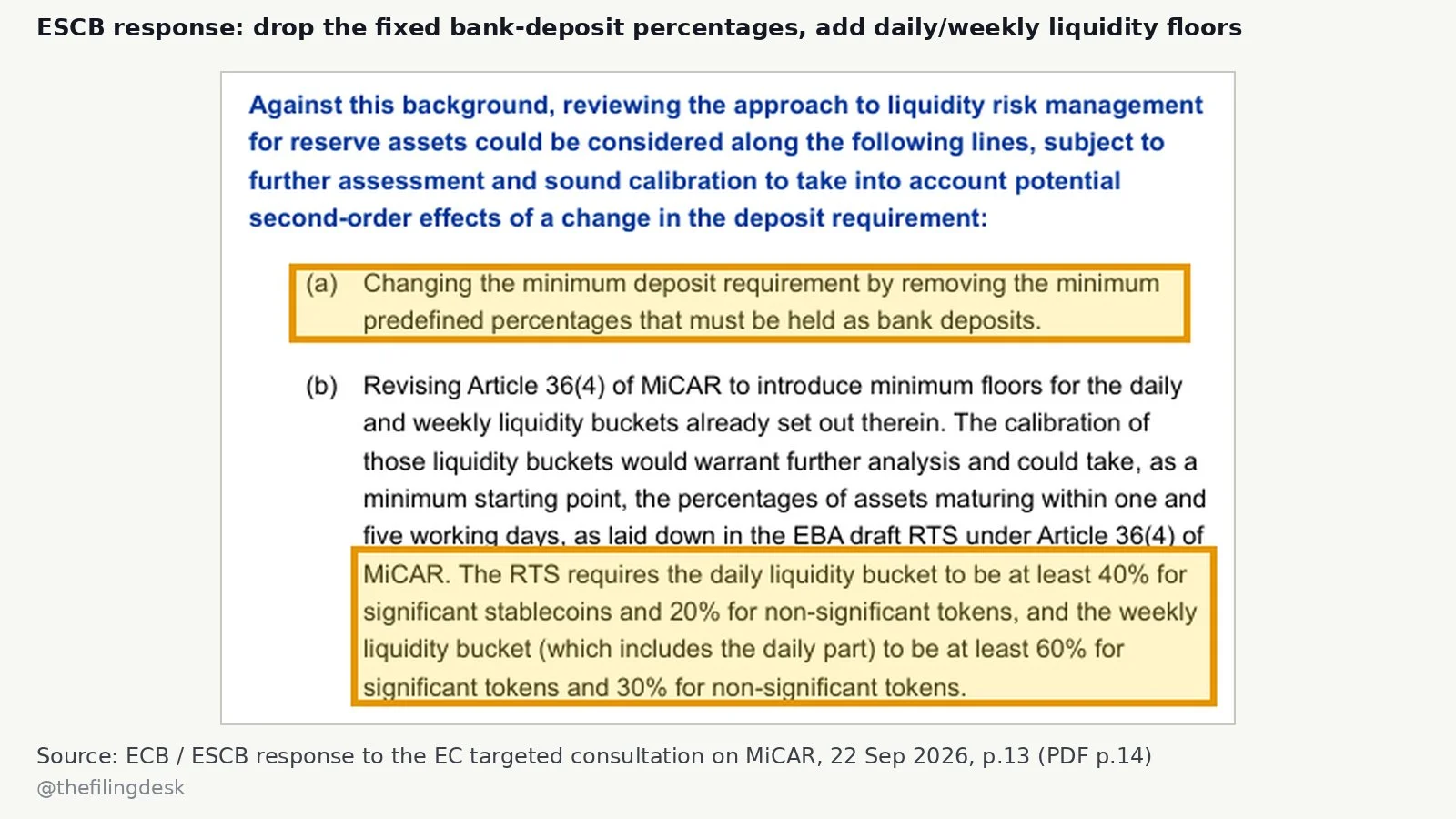
USDT issuer, Tether, declined to seek a license under the European Union’s Markets in Crypto-Assets Regulation, or MiCA, in part because of a rule requiring major stablecoin issuers to hold 60% of their reserves in bank deposits.
The requirement is now facing scrutiny from the European Central Bank and national central banks across the EU, which have called for the rule to be removed.
“Europe’s central banks want Brussels to delete a MiCA rule on stablecoin reserves. It forces large issuers to keep 60% of that money in commercial banks. Tether refused an EU license over the same clause.” https://t.co/dzkyoQFH2n pic.twitter.com/cCiXSkkmLH
— Paolo Ardoino 🤖 (@paoloardoino) September 22, 2026
Under MiCA, stablecoin issuers must hold at least 30% of their reserves as bank deposits, with the requirement rising to 60% for issuers of significant stablecoins.
The rules are designed to ensure sufficient liquidity to meet redemptions, but central banks now argue that the requirement could create risks for commercial lenders.
ECB proposes a liquidity-based approach to MiCA stablecoin reserves
The European System of Central Banks, which includes the ECB and the national central banks of the 27 EU member states, said stablecoin reserves held as bank deposits could replace relatively stable retail deposits with funding that is more sensitive to market conditions.
A large wave of stablecoin redemptions could force issuers to withdraw substantial amounts of cash from banks at short notice, potentially creating sudden funding pressure for lenders.
The ECB has previously highlighted this two-way risk, noting that stablecoins can both transmit stress from banks to issuers and from issuers back to banks.
Instead of fixed 30% and 60% deposit requirements, the ESCB has proposed focusing on the liquidity of reserve assets.
Under the approach, issuers would be required to hold specified portions of their reserves in assets that can mature or become available within one to five working days.
The proposed change could address one of the concerns Tether has raised about MiCA’s reserve framework. Tether CEO Paolo Ardoino has criticized the requirement for major stablecoin issuers to keep a large share of reserves with commercial banks, arguing that it creates additional counterparty risk.
The issue became particularly relevant after the 2023 collapse of Silicon Valley Bank, when concerns over Circle’s USDC reserves held at the bank contributed to pressure on the stablecoin’s dollar peg.
The ECB has cited the episode as an example of how bank exposure can affect stablecoin liquidity.
For now, MiCA’s 30% and 60% requirements remain in force, as the ESCB’s proposal is part of the European Commission’s review of the regulatory framework and would require changes to the existing rules before taking effect.
MiCA creates a new divide between Tether and Circle, What comes next?
While Tether has remained outside the EU’s MiCA authorization framework for USDT, other major stablecoin issuers have taken a different approach.
Circle, the issuer of USDC and EURC, has pursued MiCA compliance, creating a growing divide in how the largest stablecoin companies approach the European market.
For Tether, there are potentially two ways to bring USDT into the MiCA framework.
The first would be to establish a separate EU-authorized issuer alongside Tether’s existing entities. That issuer could issue a MiCA-compliant version of USDT backed by assets such as U.S. Treasury bills and repo agreements, broadly similar to the structure Circle uses for its compliant stablecoins.
However, this approach could face resistance from European regulators. The European System of Central Banks has raised concerns about allowing stablecoin issuers to maintain significant reserves outside the banking system while still accessing the EU market.
The second option would be to create a separate MiCA-compliant Tether token specifically for the European market, similar to Tether’s approach with USAT in the United States.
This would allow Tether to maintain its existing global USDT product while offering a version designed to meet European regulatory requirements.
Notably, the debate over MiCA’s reserve requirements could also benefit Circle. The ESCB has argued that requiring stablecoin issuers to hold a significant portion of reserves as bank deposits can affect their profitability.
If European policymakers ultimately reduce or remove that requirement, Circle could see lower costs and improved margins, particularly for EURC as it expands within the European market.
That creates an unusual dynamic: regulatory changes being discussed partly to address concerns around stablecoin issuers could benefit both Tether and Circle, but potentially in different ways.
Tether could gain a more workable path into the EU market, while Circle could benefit from lower reserve-related costs under a revised framework.
Could stablecoin rewards face a wider ban under Europe’s MiCA rules?
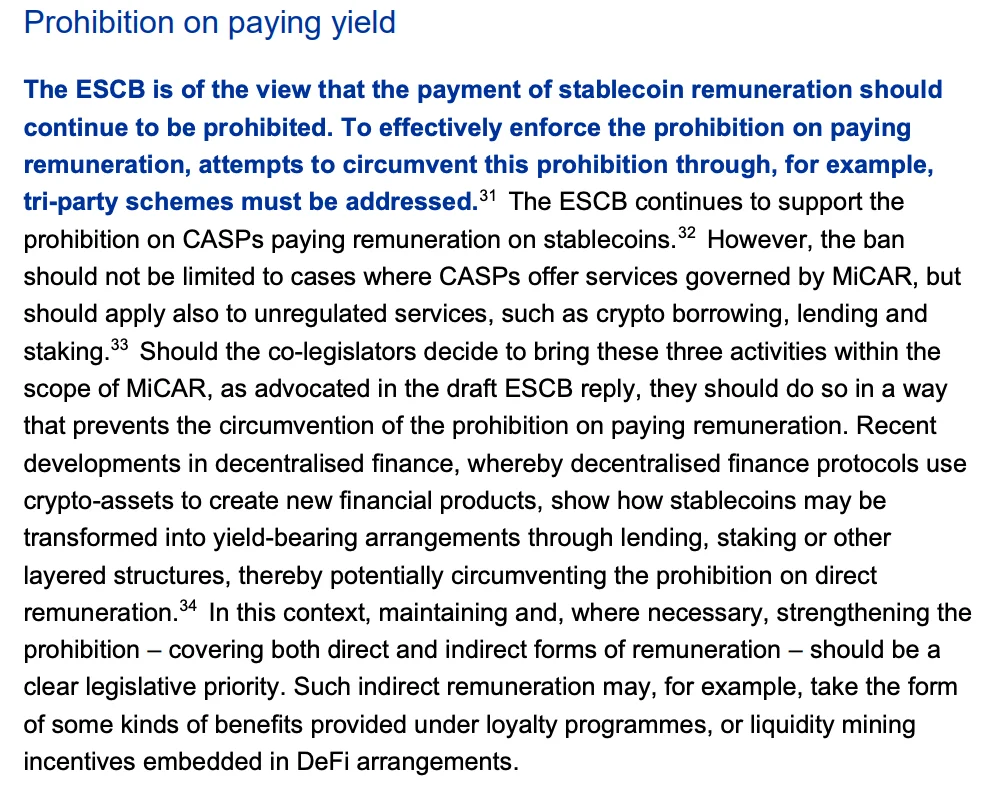
European central banks are also pushing for MiCA’s ban on stablecoin remuneration to cover indirect forms of yield generated through lending, borrowing, staking, and similar products.
MiCA already prevents crypto-asset service providers from paying interest directly on stablecoins.
However, the ESCB argues that platforms could effectively recreate interest-bearing products by placing stablecoins into other services and distributing the resulting returns to users.
The central banks said electronic money should primarily serve as a payment instrument rather than a savings product.
They warned that indirect stablecoin yields could blur the line between bank deposits and electronic money while creating different competitive conditions for banks and crypto platforms.
The issue mirrors a debate in the United States, where banking groups have pushed for tighter limits on stablecoin rewards.
U.S. banks argue that yield-like incentives could encourage customers to move funds out of traditional deposits, potentially reducing a key source of bank lending.
Stablecoin rewards also featured in negotiations over the U.S. CLARITY Act, which failed to advance in the Senate after a 49-50 procedural vote in September.
In Europe, regulators are now considering whether to adjust MiCA’s reserve requirements. The consultation is scheduled to close on September 30, while the existing 30% and 60% reserve requirements remain in place unless the rules are amended.
The ESCB has also warned that enforcing MiCA remains challenging because crypto companies outside the EU can continue providing services to European users.
Source:: Tether Rejected EU MiCA License Over 60% Reserve Rule